Key Takeaways
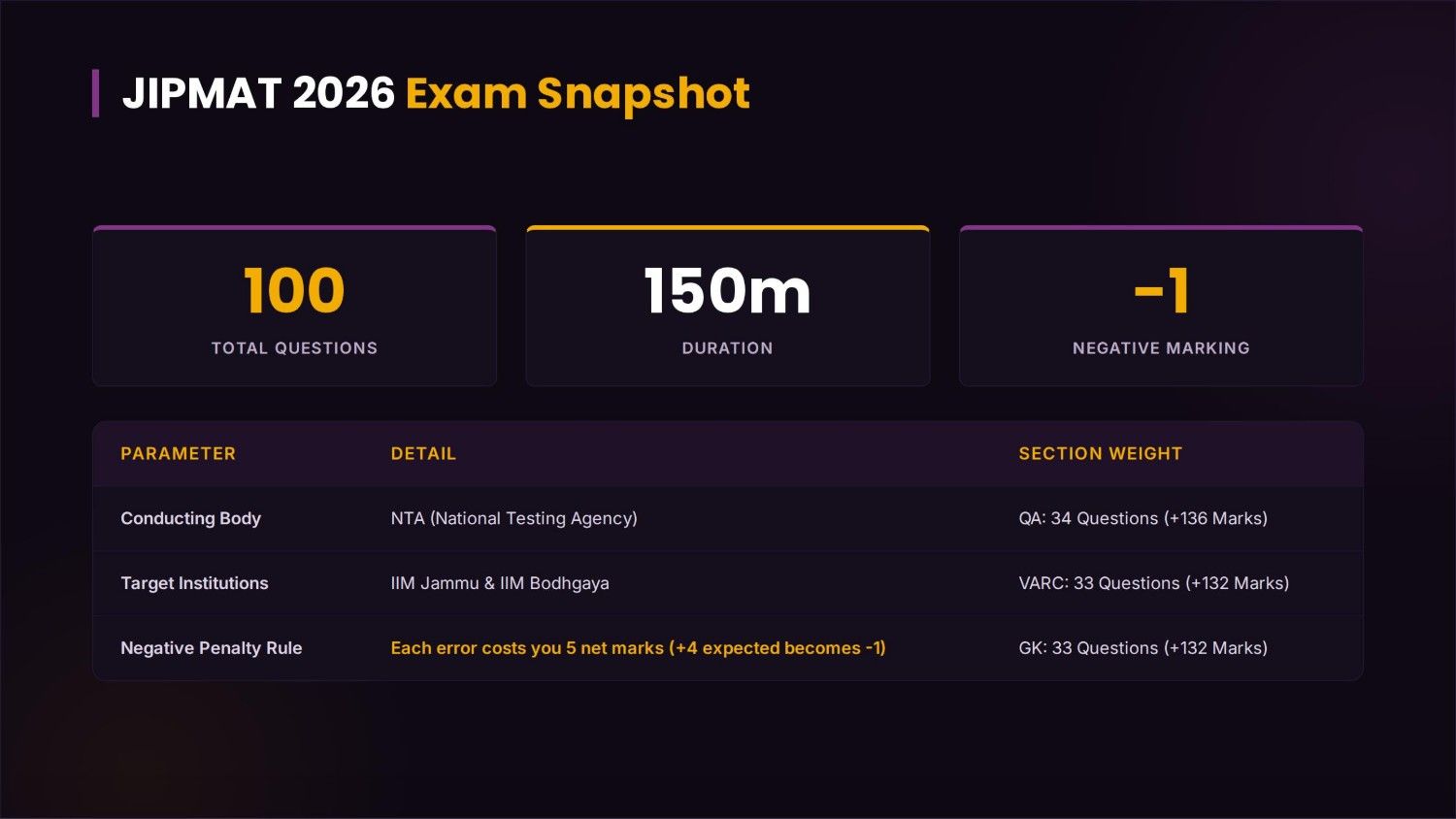
- JIPMAT 2026 has 100 questions across 3 sections — QA (34), VARC (33), GK (33) — in 150 minutes with −1 negative marking.
- In the last 3 days, accuracy beats new learning. Revise what you know; do not attempt unfamiliar topics.
- GK is the highest-risk section — preparing the right 40 topics in 3 days is more effective than covering everything broadly.
- Time management on exam day is the single biggest differentiator between qualified and eliminated candidates.
- The IIM Jammu and IIM Bodhgaya PI round follows quickly after results — begin preparation thinking ahead.
JIPMAT 2026 Exam Snapshot
Before any strategy, confirm the exam structure you are preparing for:
| Detail | JIPMAT 2026 |
|---|---|
| Exam Date | June 7, 2026 |
| Conducting Body | NTA (National Testing Agency) |
| Institutions | IIM Jammu & IIM Bodhgaya |
| Total Questions | 100 (QA: 34 | VARC: 33 | GK: 33) |
| Total Marks | 400 (+4 correct / −1 wrong) |
| Duration | 150 minutes |
| Mode | Computer-Based Test (CBT) |
| Admit Card | Download from nta.ac.in before exam day |
The negative marking rule in the last 3 days: At −1 per wrong answer, every incorrect attempt costs you 5 marks in net impact (+4 gained becomes −1 lost). In the final stretch, accuracy discipline — knowing when NOT to attempt a question — is as important as speed.
QA Last-Minute Strategy (34 Questions)
Quantitative Aptitude carries 34 questions. With 3 days remaining, the goal is not to learn new concepts — it is to solidify the high-frequency topics where your accuracy is already above 70%.
High-priority topics to revise in the next 3 days:
| Topic | Expected Questions | Revision Priority |
|---|---|---|
| Arithmetic (Ratio, %, Profit-Loss, TSD, SI-CI) | 8–12 | Must revise |
| Algebra (Linear & Quadratic Equations) | 4–6 | Must revise |
| Number Theory (Factors, LCM, HCF, Remainders) | 3–5 | Must revise |
| Geometry & Mensuration | 3–5 | Revise if strong |
| Data Interpretation | 4–6 | Revise if strong |
| Permutation, Combination & Probability | 2–4 | Attempt only if confident |
DO: Spend 45 minutes each day solving 15–20 QA questions from your previous mock tests — focus only on topics where your accuracy is already above 65%. Re-reading solved problems from your notes is faster and more effective than fresh practice right now.
IPM Careers’ PI Batch covers WAT + Personal Interview prep with IIT & IIM alumni panel → ipmcareer.com/courses
VARC Last-Minute Strategy (33 Questions)
Verbal Ability and Reading Comprehension carries 33 questions and is the section where last-minute effort pays the highest return — because VARC accuracy improves significantly with the right 3-day routine, unlike QA which requires longer concept-building.
VARC topic priorities:
| Topic | Expected Questions | 3-Day Action |
|---|---|---|
| Reading Comprehension | 10–14 | Read 2 RC passages daily (400–500 words). Practice identifying the main idea in 60 seconds before reading fully. |
| Para-jumbles | 4–6 | Practice 10 para-jumble sets. Look for the opening sentence (no pronoun reference, introduces topic) and closing sentence (conclusion/summary). |
| Grammar (Error Detection, Fill-in-the-Blanks) | 6–8 | Revise subject-verb agreement, tense consistency, preposition usage, and articles — the 4 most tested grammar rules in JIPMAT. |
| Vocabulary (Synonyms, Antonyms, Idioms) | 4–6 | Revise your existing word list — do not memorise new words 2 days before the exam. Context-elimination in the exam is more reliable than recall under pressure. |
| Sentence Correction / Improvement | 3–5 | Eliminate options with passive voice where active is possible, double negatives, and dangling modifiers — these are the fastest elimination rules. |
GK Last-Minute Strategy (33 Questions)
General Knowledge is JIPMAT’s most volatile section — and the most strategic. You cannot learn GK in 3 days. But you can revise the right 40 topics in 3 days and recover 10–15 marks from what you already know but haven’t consolidated.
GK high-frequency zones for JIPMAT 2026:
| Category | Topics to Revise | Expected Questions |
|---|---|---|
| Current Affairs (Jan–May 2026) | Union Budget highlights, major government schemes, bilateral summits, RBI policy rate, Indian elections, important appointments | 10–14 |
| Static GK — India | Constitutional articles (FR, DPSP, Preamble), National symbols, First in India, Important Acts passed recently | 6–8 |
| Economy & Business | GDP data, inflation rate (CPI/WPI), India’s ranking in global indices (Ease of Doing Business, Hunger Index, etc.), major FDI announcements | 4–6 |
| Science & Technology | ISRO missions (2025–26), major tech policy developments, AI regulations, space achievements | 3–5 |
| Sports & Awards | Recent Olympics / major tournament results, Padma Awards 2026, Nobel Prize winners 2025, Bharat Ratna | 3–4 |
| International Affairs | G20 / G7 summits, key UN appointments, India’s foreign policy moves | 2–4 |
Negative marking discipline in GK: GK is the section most aspirants over-attempt. If you are genuinely unsure — not “slightly unsure” but “genuinely guessing” — skip it. A 50% random-guess accuracy in GK gives you exactly 0 net marks (+4 − 1 − 1 = net 2 on 2 correct, 2 wrong). The expected value of blind GK guessing is negative.
Your 3-Day Plan: June 4–6
June 4 (Today) — Consolidation Day
- Morning (2 hrs): QA — revise Arithmetic and Algebra. Solve 20 questions from old mocks, error analysis only.
- Afternoon (2 hrs): VARC — read 2 RC passages, solve 15 grammar and para-jumble questions.
- Evening (2 hrs): GK — revise March and April 2026 current affairs capsule.
- Night: Confirm admit card, exam centre address, and required documents. Sleep by 10:30 PM.
June 5 — Accuracy Day
- Morning (2 hrs): Take one full-length mock or 2 section-wise timed tests (QA + VARC). Analyse every wrong answer.
- Afternoon (1.5 hrs): GK — revise May 2026 current affairs + static GK (Constitution, National Symbols, Economy data).
- Evening (1 hr): Light revision of QA formulas and shortcut sheet. No new topics.
- Night: Pack exam kit (admit card, ID proof, stationery). Sleep by 10 PM.
June 6 (Day Before) — Light Revision Only
- Morning (1.5 hrs): Read through your formula sheet and GK revision notes. No mock tests today.
- Afternoon: Rest. Physical and mental recovery is preparation. Fatigue on exam day costs more marks than 3 additional hours of study the day before.
- Evening (30 min): Verify exam centre route and travel time. Aim to reach the centre 30 minutes early on June 7.
- Night: Dinner by 8 PM. In bed by 10 PM. 8 hours of sleep is non-negotiable.
Exam Day Strategy: How to Use 150 Minutes
| Time Block | Section | Target | Key Rule |
|---|---|---|---|
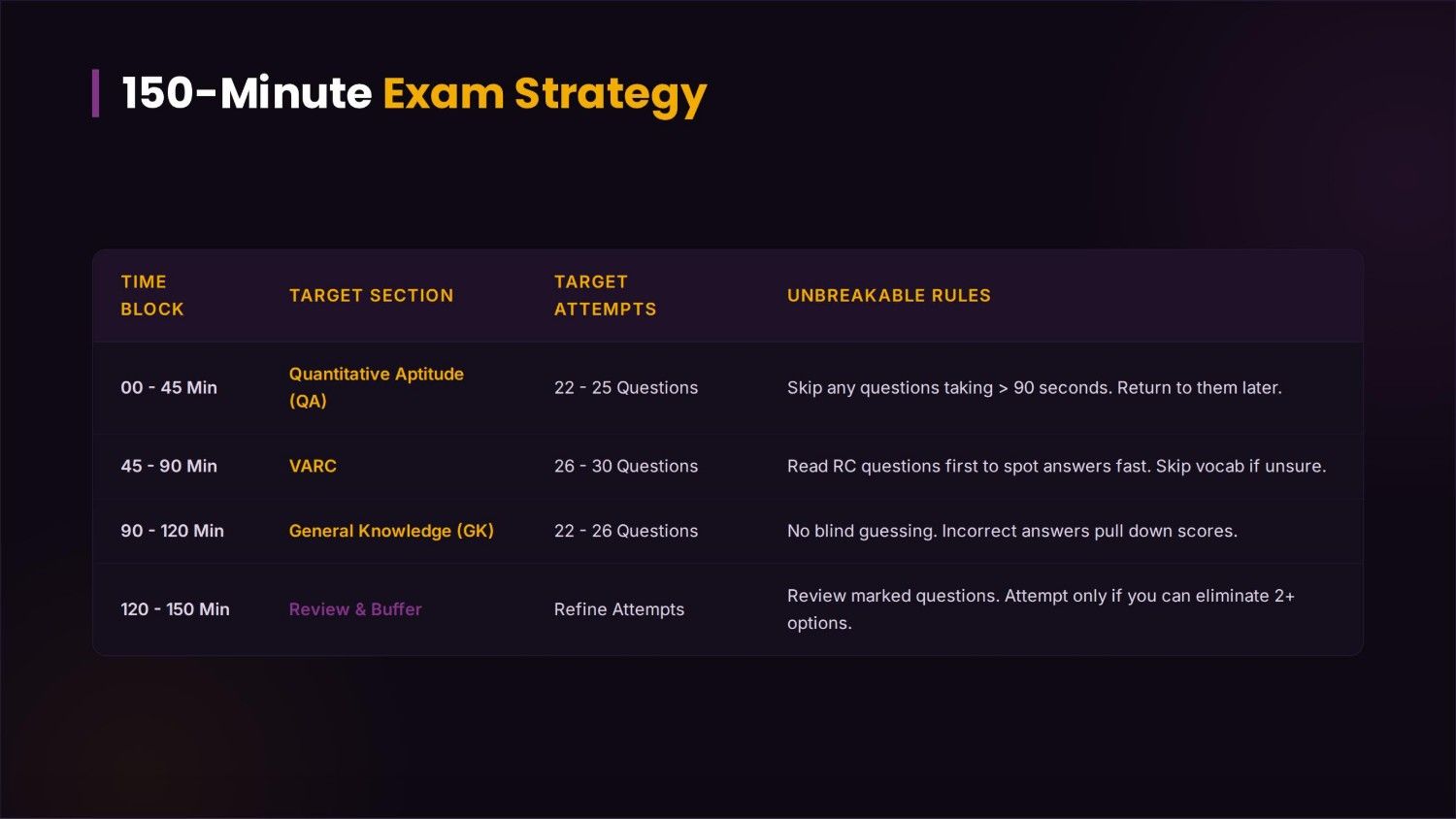
| 0–45 min | QA | Attempt 22–25 questions | Skip anything taking >90 seconds. Mark for review. |
| 45–90 min | VARC | Attempt 26–30 questions | Read RC questions first, then passage. Skip vocab if unsure. |
| 90–120 min | GK | Attempt 22–26 questions | Only answer what you genuinely know. Skip blind guesses. |
| 120–150 min | Review | Return to marked questions | Attempt only if you can eliminate 2+ options. Otherwise leave. |
The discipline that decides scores on exam day: Candidates who finish each section with 5–8 minutes to spare and use those minutes for review consistently score 15–20 marks higher than candidates who time out. Speed with accuracy — not speed alone — is what JIPMAT’s marking scheme rewards.
Frequently Asked Questions
Is JIPMAT 2026 on June 7 confirmed?
Yes. JIPMAT 2026 is scheduled for June 7, 2026, conducted by NTA. Download your admit card from nta.ac.in before exam day and verify exam centre details.
How many questions should I attempt in JIPMAT 2026 to clear the cutoff?
There is no officially declared fixed cutoff score for JIPMAT — the merit list is relative. As a benchmark, attempting 70–75 questions with 80%+ accuracy (netting approximately 200–230 marks) has historically been competitive for IIM Jammu and IIM Bodhgaya shortlisting.
What GK topics are most important for JIPMAT 2026?
Current Affairs from January to May 2026 carry the highest weight. Focus on Union Budget 2026 highlights, major government schemes, RBI policy decisions, India’s international relations, and important appointments. Static GK on the Indian Constitution and National Symbols is also regularly tested.
Should I attempt all 100 questions in JIPMAT 2026?
No. With −1 negative marking, blind attempts are net-negative. Target 70–80 high-confidence attempts rather than 100 low-confidence ones. Quality of attempts matters more than quantity on this paper.
What happens after JIPMAT 2026 results?
Shortlisted candidates are called for a Personal Interview (PI) round by IIM Jammu and IIM Bodhgaya. The PI round carries significant weightage in the final selection composite. Begin PI preparation immediately after the exam — the window between result and interview is short.
Conclusion
Three days is not the time for new learning — it is the time for surgical consolidation. The aspirants who perform best on June 7 are not necessarily those who covered the most topics in the week before. They are the ones who locked in their strongest sections, protected their score from negative marking errors, and arrived at the exam centre well-rested and mentally sharp.
Follow the 3-day plan. Respect the negative marking. Manage 150 minutes by section. And remember — clearing JIPMAT 2026 is the start, not the finish. IIM Jammu and IIM Bodhgaya’s PI round follows quickly after results, and that round is where IIM seats are ultimately secured.
All the best for June 7.
Join Best IPMAT Coaching in India Now
Have a look at our best courses for your IPMAT Preparation.
Checkout our variety of courses for your IPMAT Preps.
Useful Links :
IIM Indore
IIM Rohtak