
Didn’t Crack IPMAT 2026? The Dropper’s Roadmap to IIM in 2027
The results are out. Your name isn’t on the merit list.
Maybe you were 5 marks short. Maybe it was one bad section that pulled your total below the cutoff. Maybe you didn’t even get to the shortlist stage. Whatever happened — right now it stings. And that’s okay.
But here’s the truth that most students don’t hear soon enough: dropping a year for IPMAT is not a setback. For hundreds of students, it’s been the decision that changed everything.
At IPM Careers, we’ve coached students who cleared IPMAT on their second and even third attempt — and went on to IIM Indore, IIM Rohtak, and IIM Ranchi. The ones who make it the second time don’t just “study harder.” They study smarter. They know exactly what broke down in their first attempt, and they fix it systematically.
This blog gives you that roadmap. And at the bottom, we’ll tell you how to get a head start — completely free.
Joining IPM Careers’ Free Dropper’s Webinar?
On 20th June, 2026 we’re hosting a live session exclusively for IPMAT 2026 non-qualifiers. Our faculty will walk through gap analysis, a month-by-month 2027 prep calendar, and answer your questions live.
Register here — it’s free →
Why Most IPMAT Droppers Fail the Second Time (And How to Not Be One of Them)
Every year, a large chunk of IPMAT candidates who sit for the exam a second time don’t make it — not because they aren’t smart enough, but because they repeat the same mistakes with more confidence. The three most common traps:
1. No Honest Post-Mortem of IPMAT 2026
Most repeaters start preparing within days of the result, without ever properly diagnosing why they missed out. Was it speed in the Quantitative Ability section? Was it the Short Answer format catching you off-guard? Did you lose marks in Verbal Ability because of weak reading comprehension or grammar gaps? Without a forensic breakdown of your 2026 attempt, you’re preparing blind.
2. Imbalanced Preparation
IPMAT Indore 2026 had three sections: Quantitative Ability (MCQ), Quantitative Ability (Short Answer), and Verbal Ability. The Short Answer section — where negative marking doesn’t apply but partial attempts are penalised by omission — is where most aspirants either gain a decisive edge or surrender easy marks. Many students spend 80% of their time on MCQ Quant, which is often already their stronger area, while their SA accuracy and VA percentile stagnate.
3. No Milestone Check-Ins
A full year of preparation without structured mock tests, sectional tests, and timed full-lengths creates false confidence. Students study for months, feel ready — and then collapse under actual exam conditions. Preparation without pressure-testing isn’t preparation; it’s reading.
What You’re Up Against in IPMAT 2027: Know the Numbers
Understanding the competition is not about scaring yourself — it’s about calibrating your effort correctly.
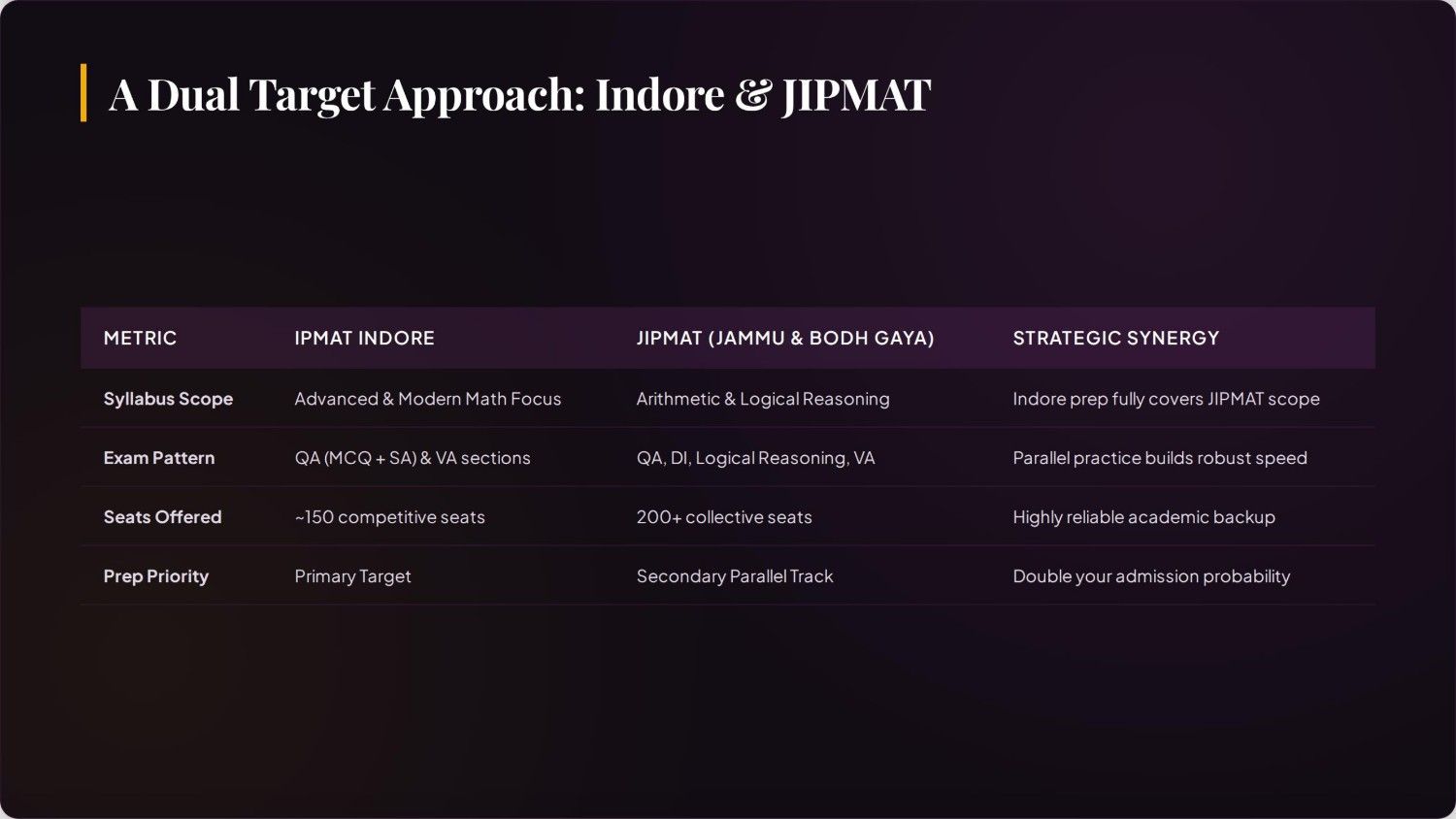
- IIM Indore IPM seats (2026): ~150 seats across all categories (General, OBC-NC, SC, ST, EWS, PwD). Competition for Open Category seats is the toughest.
- Applicants: IPMAT Indore attracts approximately 30,000–35,000+ applicants each cycle. The shortlisting ratio for the PI stage is typically under 10:1.
- Typical Open Category cutoff (2026): Around 140–155+ out of 200 for the MCQ paper, with strong SA performance required for shortlisting.
- JIPMAT (IIM Jammu + IIM Bodh Gaya): A separate exam with a combined 200+ seats — an important parallel target.
The good news for droppers: you’ve already attempted the exam once. You know the format, the pressure, the pacing. First-timers don’t. That’s a real, meaningful advantage — if you use the year well.
The 12-Month Dropper’s Roadmap: June 2026 to May 2027
This isn’t a vague “study hard” plan. It’s a phase-by-phase framework you can adapt to your current level.
Phase 1: Reset & Rebuild (June – July 2026)
Goal: Know your enemy.
Before you open a single textbook, do a full audit of your IPMAT 2026 performance. Pull your scorecard and answer these questions honestly:
- Which section did you score lowest in relative to the cutoff?
- In Quant MCQ: were your errors careless mistakes or concept gaps?
- In Quant SA: how many questions did you attempt vs. get right?
- In Verbal: was it comprehension speed, vocabulary, or grammar errors?
This gap analysis will define your entire year. Don’t skip it.
Alongside the audit, use this phase to strengthen your weakest chapter clusters. For most students who fall short, the bottleneck is one of: Number Theory (Quant SA), Reading Comprehension speed (VA), or Arithmetic accuracy under time pressure (Quant MCQ). Focus brutally here for six to eight weeks.
Phase 2: Core Build (August – October 2026)
Goal: Cover every syllabus topic at depth.
By the end of Phase 2, there should be no topic in the IPMAT syllabus that you haven’t revised at least once at problem-solving level. This means:
- Quant: Algebra, Geometry, Number Theory, Modern Maths (P&C, Probability, Functions), Data Interpretation
- Verbal: Reading Comprehension (varied passage types: science, economy, history, literature), Grammar & Usage, Vocabulary in Context, Para-jumbles, Critical Reasoning
Keep a dedicated “error log” — every question you get wrong goes into a notebook with your mistake reason (concept gap / careless / unfamiliar type). Review it every Sunday.
Phase 3: Mock-Intensive Block (November 2026 – January 2027)
Goal: Convert knowledge into exam performance.
Start full-length IPMAT mocks — minimum one per week, ideally two. After every mock:
- Calculate your expected score on both QA sections and VA
- Compare to your target percentile
- Identify if the gap is speed, accuracy, or topic coverage
- Fix the specific issue before the next mock — not after the next five
This is also the stage to practice the Short Answer section specifically. SA questions require a different skill: no guessing, high precision, clean computation. Set aside 20–30 minutes of dedicated SA practice three times a week.
Phase 4: Sharpening & Revision (February – March 2027)
Goal: Peak form, no new topics.
Stop learning new things. Start refining what you already know. This phase is about raising your mock average and consistency — the difference between scoring 138 sometimes and scoring 142–148 reliably. Revisit your error log. Go back to your weakest chapters. Do timed sectional tests (not just full mocks) to target speed specifically.
Phase 5: Final Sprint (April – Exam Day, May 2027)
Goal: Stay sharp, stay calm.
Reduce new mock attempts; focus on review. Maintain a daily practice habit of 60–90 minutes of mixed problem-solving. Revisit high-frequency topics. Get your exam-day logistics sorted early — admit card, centre location, ID documents. On the night before, do not cram. Sleep.
What Successful IPMAT Droppers Do Differently
We’ve seen this pattern consistently across students who clear IPMAT on their second attempt:
They set a score target, not a “study hours” target. Instead of “I’ll study 8 hours a day,” they work backwards from the cutoff — “I need 148+ to be safe; right now I’m averaging 131 on mocks; I need to close a 17-mark gap in specific areas.” Every week’s work flows from that number.
They don’t ignore PI preparation until after the written exam. The Personal Interview at IIM Indore is genuinely rigorous — it tests academic depth, current affairs, and communication. Students who start light PI prep in Phase 3 are far less scrambled during the PI window than those who start after the results are announced.
They stay enrolled in structured coaching. The accountability of a coach, a peer group, and a structured syllabus is difficult to replicate through solo preparation. Not impossible — but significantly harder.

Your First Step: Join the Free Dropper’s Roadmap Webinar
If you’re reading this right after your IPMAT 2026 result, you’re in exactly the right headspace — motivated, honest, and ready to do things differently. We want to help you channel that energy into a structured plan before it fades.
On 20th June, 2026, IPM Careers is hosting a free live webinar exclusively for IPMAT 2026 non-qualifiers — and it covers everything you need to start your 2027 journey the right way.
What We’ll Cover in the Webinar
- Live gap analysis: How to dissect your IPMAT 2026 scorecard and pinpoint exactly where marks were lost
- Section-wise strategy for IPMAT 2027: What changed, what stayed the same, and where to prioritise your effort
- The 12-month prep calendar: Month-by-month targets from June 2026 to exam day
- Coaching vs. self-study: An honest breakdown of what each path looks like for a dropper
- Live Q&A: Ask our faculty your specific questions directly
Free Webinar: IPMAT 2027 Dropper’s Roadmap
Date: 20th June, 2026
Reserve My Free Seat →Seats are limited. No cost, no sales pressure — just a clear plan to crack IPMAT 2027.
Frequently Asked Questions — IPMAT Dropper & 2027 Preparation
Is one year enough to crack IPMAT 2027 if I missed in 2026?
Absolutely. One year is more than enough — in fact, it’s an advantage. You’ve already sat for the exam and know the format. Most students who use the year systematically (gap analysis → core preparation → mock-intensive phase) see a significant score jump. The key is not just “more time” but structured time.
Should I target IPMAT Indore only, or also JIPMAT?
You should target both. JIPMAT (for IIM Jammu and IIM Bodh Gaya) is a separate exam with a different structure but overlapping syllabus. It’s a legitimate backup that many IIM IPM students enroll in alongside their Indore preparation. Running both targets in parallel doesn’t significantly increase workload, since the core preparation is shared.
At what score did most IPMAT 2026 shortlists happen?
The exact cutoffs depend on category and fluctuate each year based on paper difficulty. Historically, General Category shortlists for IIM Indore’s PI round have required scores in the range of 140–155 out of 200 (MCQ paper), with consistent performance in the Short Answer section. Your target for 2027 should be 148+ to be competitive across categories and centres.
Is coaching necessary as a dropper, or can I self-study?
Self-study can work for students with very specific, well-understood gaps and strong discipline. However, most droppers benefit significantly from structured coaching — not because they can’t study on their own, but because coaching provides peer accountability, regular mock infrastructure, and expert feedback that’s very hard to replicate alone. The decision depends on your honest assessment of why you missed out in 2026.
When should I start my IPMAT 2027 preparation?
Now. Not next month. The students who crack IPMAT on their second attempt are usually the ones who started their structured prep within 30 days of their first result — while the gap analysis is fresh and the motivation is real. Starting in June gives you 11–12 months of structured preparation, which is the ideal runway.
The Bottom Line
Missing IPMAT 2026 is not the end of your IIM story. For many students, it’s chapter one.
The dropper’s year — done right — produces candidates who walk into IPMAT 2027 with stronger fundamentals, more exam experience, and a precision that first-time candidates simply don’t have. The IIM IPM journey is a five-year program that will shape your career for decades. One extra year of focused preparation is an investment that pays back a hundredfold.
Start with the webinar. Come in with your scorecard, your questions and your determination. We’ll help you build the plan from there.
Join Best IPMAT Coaching in India Now
Have a look at our best courses for your IPMAT Preparation.
Checkout our variety of courses for your IPMAT Preps.
Useful Links :
IIM Indore
IIM Rohtak