Key Takeaways
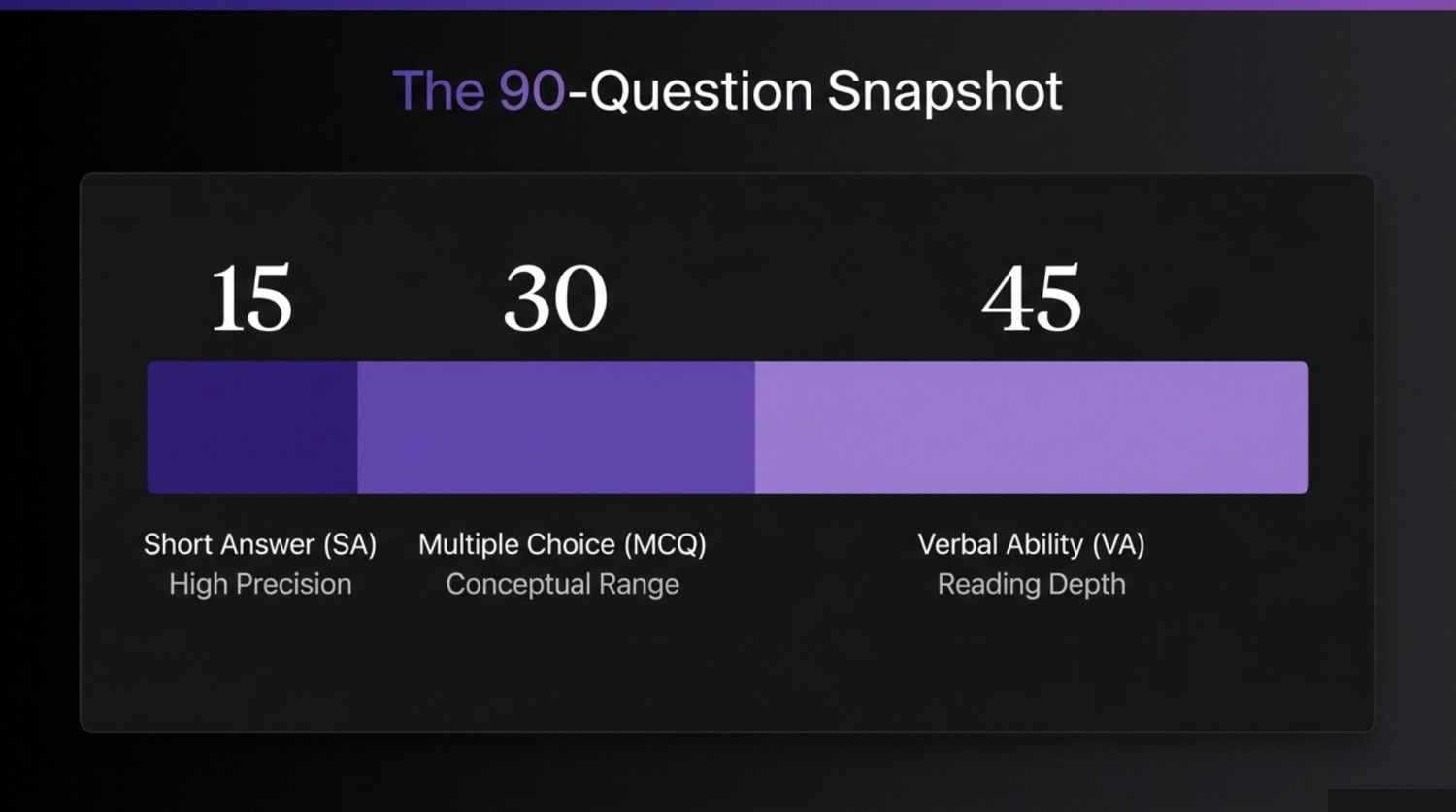
- The IPMAT 2026 paper has 90 questions across three sections: SA (15), MCQ (30), and VA (45)
- The QA section combined SA and MCQ — covering Arithmetic, Algebra, Geometry, Number Theory, Combinatorics, and Data Interpretation
- VA featured 2 Reading Comprehension passages, sentence correction, vocabulary, paragraph completion, and conversation analysis
- This post includes the complete official answer key for all three sections
- For 2027 aspirants: this paper is now your most valuable mock resource — solve it in timed conditions
You just sat one of the most competitive management entrance exams in the country. Whether today felt smooth or shaky, one fact doesn’t change: this paper is now data. The questions, the topic mix, the difficulty distribution — all of it tells you exactly what IIM-standard preparation looks like. Read on.
1. IPMAT 2026 Paper: At a Glance
| Section | Question Type | No. of Questions |
|---|---|---|
| Quantitative Aptitude — Short Answer (SA) | Numeric entry, no options | 15 |
| Quantitative Aptitude — MCQ | 4 options | 30 |
| Verbal Ability (VA) | 4 options | 45 |
| Total | 90 |
The paper maintained IPMAT Indore’s signature structure: a rigorous QA block demanding both calculation precision (SA) and conceptual clarity (MCQ), followed by a VA section that rewarded reading depth and vocabulary range — not rote learning.
Click Here :Download the IPMAT 2026 Question Paper PDF
2. Section-wise Analysis
Quantitative Aptitude — Short Answer (SA)
The SA section demanded exact numerical answers with zero room for guessing. The 15 questions covered a wide range of topics:
- Q1 (Speed, Distance, Time): A classic relative speed problem — man walking at 4 km/hr, woman starting 30 minutes later at 6 km/hr. Answer: 10 km
- Q3 (Profit & Loss with Marked Price): A multi-step problem involving purchase price, discounts, and layered profit percentages. Answer: ₹60
- Q7 (Matrices & Determinants): Given a Vandermonde-style determinant matrix with constraint a + b + c = 0 — required working knowledge of matrix properties. Answer: 5
- Q14 (Ratio & Worker Problems): Three-step ratio problem tracking foreign-to-domestic worker composition through two changes. Answer: 72
- Q15 (Compound Interest with Partial Payment): Savitri’s two-year loan at 10% p.a. compounded semi-annually, with ₹5,025 paid at year-end. Answer: ₹6,615
SA Difficulty: High. SA questions required precision — no partial credit, no elimination strategy. Seven of the 15 questions involved two or more mathematical concepts layered together.
Quantitative Aptitude — MCQ
The 30 MCQ questions spanned a broader topic range, including a dedicated Data Interpretation set on nutrition (Q26–Q30):
| Topic | Questions | Difficulty |
|---|---|---|
| Work & Time, Ratios | Q1, Q14 | Moderate |
| Geometry (Circle, Rectangle, Tracks) | Q2, Q5, Q10, Q17 | Moderate–Hard |
| Algebra & Polynomials | Q3, Q16 | Hard |
| Number Theory & Primes | Q8, Q11, Q18 | Hard |
| Permutations & Combinations | Q4 | Moderate |
| Series & Sequences (GP/AP) | Q9 | Easy–Moderate |
| Logarithms | Q13, Q24 | Hard |
| Probability & Statistics | Q20–Q22, Q25 | Moderate |
| Data Interpretation (Nutrition) | Q26–Q30 | Moderate |
MCQ Highlight — Q7 (Infinite Series Geometry): Gita walks in a spiral — east 1000m, north 800m, west 640m, south 512m, and so on infinitely, each step 20% shorter. Aspirants needed to resolve this into two independent geometric series (east-west and north-south displacement) and apply the Pythagoras theorem on the resultant coordinates. Answer: (d) 781 m
MCQ Difficulty: Moderate to Hard. The Data Interpretation set (Q26–30) offered relative relief and was the strategic scoring zone in this section.
Verbal Ability (VA)
The 45-question VA section was structured as follows:
| Sub-type | Questions | Count |
|---|---|---|
| Reading Comprehension — Passage 1 (Animal Communication) | Q1–Q6 | 6 |
| Reading Comprehension — Passage 2 (Rage Bait / Social Media) | Q7–Q12 | 6 |
| Idiom / Vocabulary Fill-in-the-Blank | Q13–Q19 | 7 |
| Error Identification & Correction | Q20–Q24 | 5 |
| Paragraph Completion | Q25–Q28 | 4 |
| Word Fill (Cloze) | Q29–Q34 | 6 |
| Conversation Analysis (Ancient Egypt / Nile) | Q35–Q40 | 6 |
| Sentence Sequencing (Para-Jumbles) | Q41–Q45 | 5 |
What stood out in VA 2026: The two RC passages were unusually rich in inference-based questions. The animal communication passage tested careful reading of author intent, not just fact retrieval. The rage-bait passage — drawing on the Oxford Word of the Year 2025 — required aspirants to engage with contemporary digital literacy arguments. The conversation analysis set on Ancient Egypt was the most unique sub-type, rewarding aspirants who could process academic dialogue rather than just edited prose.
VA Difficulty: Moderate. Vocabulary questions (Q13–Q19) were straightforward for well-read aspirants. The para-jumbles (Q41–Q45) were moderately complex but solvable with elimination.
3. IPMAT 2026 Answer Key
Short Answer (SA)
| Q1 | Q2 | Q3 | Q4 | Q5 | Q6 | Q7 | Q8 | Q9 | Q10 | Q11 | Q12 | Q13 | Q14 | Q15 |
|---|---|---|---|---|---|---|---|---|---|---|---|---|---|---|
| 10 | 7 | 60 | 5 | 106 | 4 | 5 | 54 | 2 | 6 | 122 | 3 | 2 | 72 | 6615 |
MCQ Answer Key
| Q | Ans | Q | Ans | Q | Ans | Q | Ans | Q | Ans |
|---|---|---|---|---|---|---|---|---|---|
| 1 | b | 7 | d | 13 | c | 19 | b | 25 | d |
| 2 | d | 8 | c | 14 | b | 20 | b | 26 | c |
| 3 | d | 9 | d | 15 | c | 21 | b | 27 | b |
| 4 | a | 10 | c | 16 | a | 22 | a | 28 | c |
| 5 | a | 11 | c | 17 | d | 23 | b | 29 | c |
| 6 | a | 12 | c | 18 | c | 24 | a | 30 | b |
VA Answer Key
| Q | Ans | Q | Ans | Q | Ans | Q | Ans | Q | Ans |
|---|---|---|---|---|---|---|---|---|---|
| 1 | c | 10 | a | 19 | d | 28 | c | 37 | d |
| 2 | a | 11 | a | 20 | c | 29 | b | 38 | b |
| 3 | a | 12 | d | 21 | b | 30 | b | 39 | d |
| 4 | b | 13 | c | 22 | b | 31 | a | 40 | c |
| 5 | a | 14 | d | 23 | c | 32 | c | 41 | a |
| 6 | a | 15 | d | 24 | d | 33 | a | 42 | b |
| 7 | c | 16 | d | 25 | c | 34 | c | 43 | b |
| 8 | a | 17 | d | 26 | b | 35 | c | 44 | a |
| 9 | b | 18 | c | 27 | d | 36 | a | 45 | b |
4. How to Use This Paper for IPMAT 2027 Preparation
This paper is now your most relevant practice resource. Here’s how to extract maximum value from it:
Step 1 — Take it as a timed full mock. If you haven’t already, solve the full paper under timed conditions before looking at any solutions. QA: 60 minutes. VA: 40 minutes.
Step 2 — Categorise every wrong answer. For each error, label it: Concept Gap / Silly Mistake / Time Pressure. Each category requires a different fix.
Step 3 — Prioritise the SA section. SA questions cannot be guessed. Every SA topic that cost you marks is a high-priority gap to close before next year.
Step 4 — Mine the VA passage structure. The RC passages in IPMAT 2026 required inferential reading, not just scanning. Build this skill by reading 2–3 quality opinion pieces daily.
Step 5 — Revisit the Data Interpretation set (MCQ Q26–30). The nutrition table-based questions were the most accessible MCQs on the paper. In a time-pressured exam, these are your confidence and scoring zone — solve them first.
Preparing for IPMAT 2027? IPM Careers’ Full-Year Programme is built around papers exactly like this one — with IIM alumni faculty, 50+ mocks, and personalised mentoring. Enrol now at register.ipmcareer.com

Frequently Asked Questions
Is this the official IPMAT 2026 question paper?
This is the IPMAT 2026 question paper compiled and made available by IPM Careers — run by IIM alumni — for aspirants to practise and analyse.
How many questions are in the IPMAT 2026 paper?
90 questions total: 15 SA (Short Answer), 30 MCQ in the Quantitative Aptitude section, and 45 questions in Verbal Ability.
Is there negative marking in the IPMAT 2026 paper?
Negative marking applies to MCQ questions (–1 per wrong answer). The SA section carries no negative marking — only correct numeric answers earn marks.
Which topics were most heavily tested in QA 2026?
Geometry, Number Theory, Logarithms, and multi-step Profit & Loss / Interest problems appeared most frequently across both SA and MCQ sections.
What was the toughest section in IPMAT 2026?
The SA section demanded the highest precision. Among MCQ, Q3 (Polynomial Factorisation) and Q7 (Infinite Series Geometry) were considered the hardest by most aspirants.
Can I use this paper to prepare for IPMAT 2027?
Yes — this is your most current and relevant practice material. Solve it timed, analyse your errors by category, and rebuild weak topics before your next attempt.
Conclusion
The IPMAT 2026 paper maintained the high-concept, multi-step difficulty that IIM Indore is known for. Strong scorers in QA will have prioritised the DI set and avoided blind guessing in the MCQ section. Strong scorers in VA will have read the RC passages closely before attempting any questions.
If today’s paper exposed gaps — in Geometry, Logarithms, Probability, or RC inference — treat that as a precise diagnosis, not a verdict. The aspirants who convert IPMAT shortlists into IIM Indore seats are those who use every paper, including this one, as a training resource.
Still aiming for an IIM? IPM Careers’ WAT-PI Crack Programme and 2027 Full-Year Programme are open for enrolment. Book a free counselling call at register.ipmcareer.com
Join Best IPMAT Coaching in India Now
Have a look at our best courses for your IPMAT Preparation.
Checkout our variety of courses for your IPMAT Preps.
Useful Links :
IIM Indore
IIM Rohtak