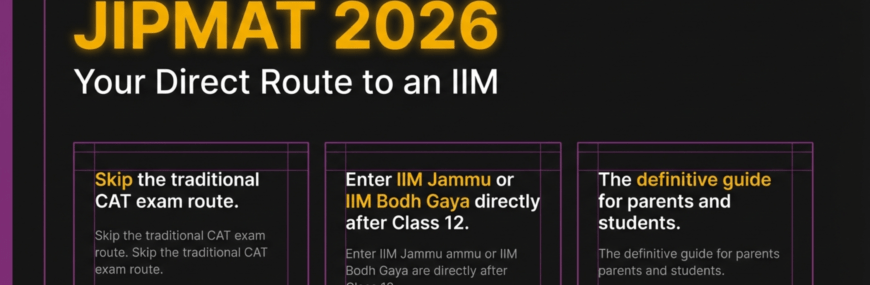
JIPMAT 2026: Exam Date, Pattern, Syllabus, Cutoff & Complete Preparation Guide
Key Takeaways
- JIPMAT 2026, conducted by NTA, is the gateway to the 5-year Integrated Programme in Management (IPM) at IIM Jammu and IIM Bodh Gaya.
- The exam has 100 MCQs across three sections — QA, DILR, and VARC — worth 400 marks in 150 minutes, with no sectional time limit.
- IIM Jammu offers approximately 120–140 IPM seats with total fees around ₹30.85 lakh; IIM Bodh Gaya offers 120 seats at approximately ₹38 lakh.
- General category cutoffs have historically hovered around 280–350 (raw score), depending on exam difficulty and the IIM.
Table of Contents
- What is JIPMAT? (2026 Overview)
- JIPMAT 2026 Exam Date & Registration Timeline
- JIPMAT 2026 Exam Pattern & Marking Scheme
- JIPMAT 2026 Eligibility Criteria
- JIPMAT 2026 Syllabus: Section-Wise Breakdown
- IIM Jammu IPM 2026: Fees, Seats & Placements
- IIM Bodh Gaya IPM 2026: Fees, Seats & Placements
- JIPMAT Cutoff Trends: Category-Wise Analysis
- How to Prepare for JIPMAT 2026: Section-Wise Strategy
- Best Books & Resources for JIPMAT 2026
- Common Mistakes to Avoid
- JIPMAT vs IPMAT: Key Differences
- Frequently Asked Questions about JIPMAT 2026
- Conclusion
What is JIPMAT? (2026 Overview)
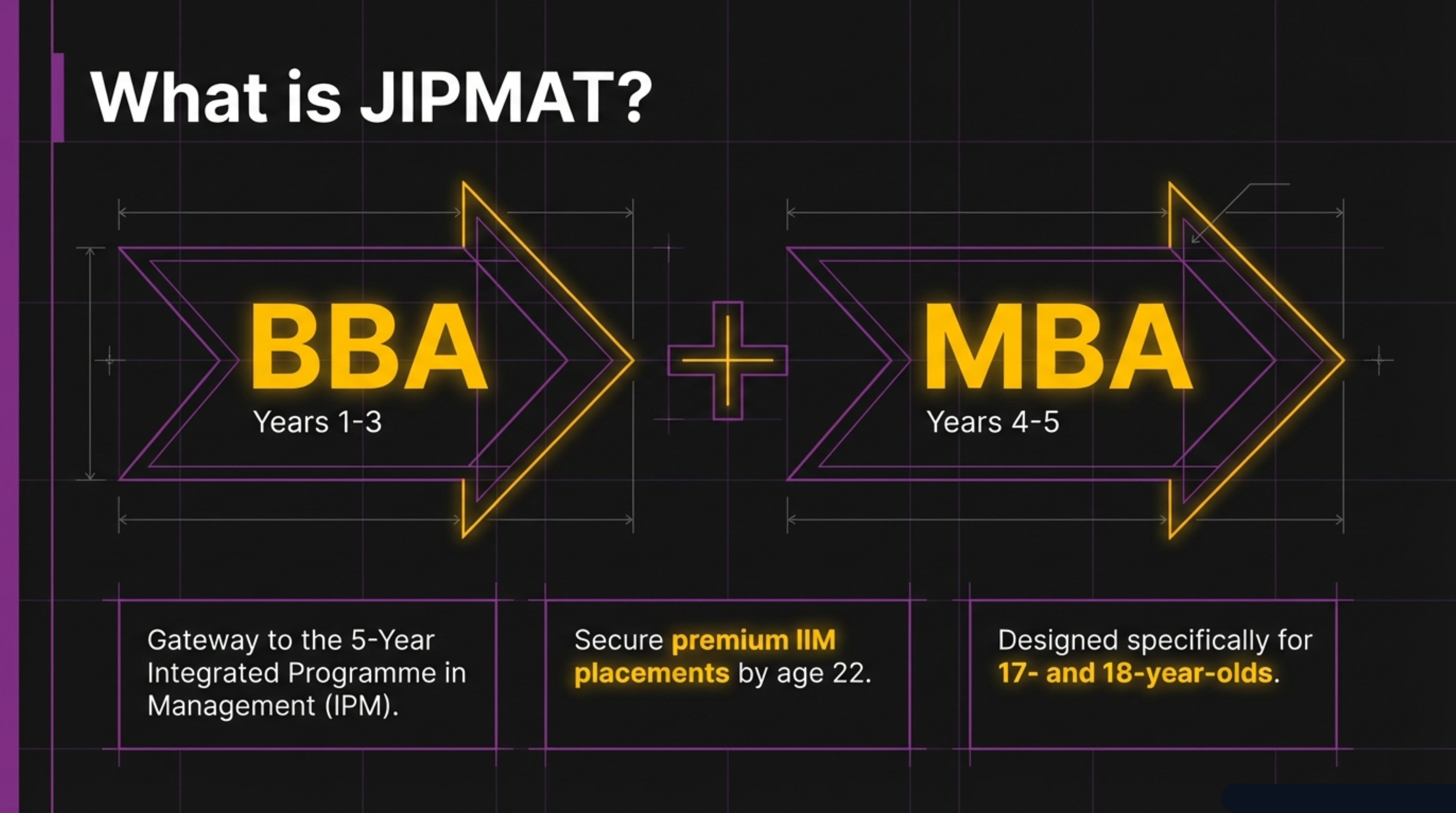
JIPMAT — the Joint Integrated Programme in Management Admission Test — is a national-level entrance exam conducted by the National Testing Agency (NTA) for admission to the 5-year Integrated Programme in Management at IIM Jammu and IIM Bodh Gaya. Students who clear JIPMAT and the subsequent selection process earn dual degrees: a BBA (Years 1–3) followed by an MBA (Years 4–5) from an IIM.
The exam was introduced in 2021 as a standardised gateway for students who want to enter an IIM directly after Class 12, without the traditional CAT-after-graduation route. Since then, JIPMAT has grown steadily in applicant volume — and for good reason. It gives 17- and 18-year-olds a direct path to an IIM campus, five years of structured management education, and access to IIM placements by age 22.
For the 2026 cycle, both IIM Jammu and IIM Bodh Gaya will use JIPMAT scores as the primary selection metric, with additional weightage for gender diversity. NTA is expected to conduct the exam in computer-based test (CBT) mode across 75+ cities in India.
Exploring JIPMAT 2026? Download IPM Careers’ free JIPMAT study plan and section-wise preparation guide → ipmcareer.com/free-resources
JIPMAT 2026 Exam Date & Registration Timeline
As of March 2026, NTA has not yet released the official JIPMAT 2026 notification. Based on previous years’ patterns, here is the expected timeline:
| Event | Expected Date (2026) |
|---|---|
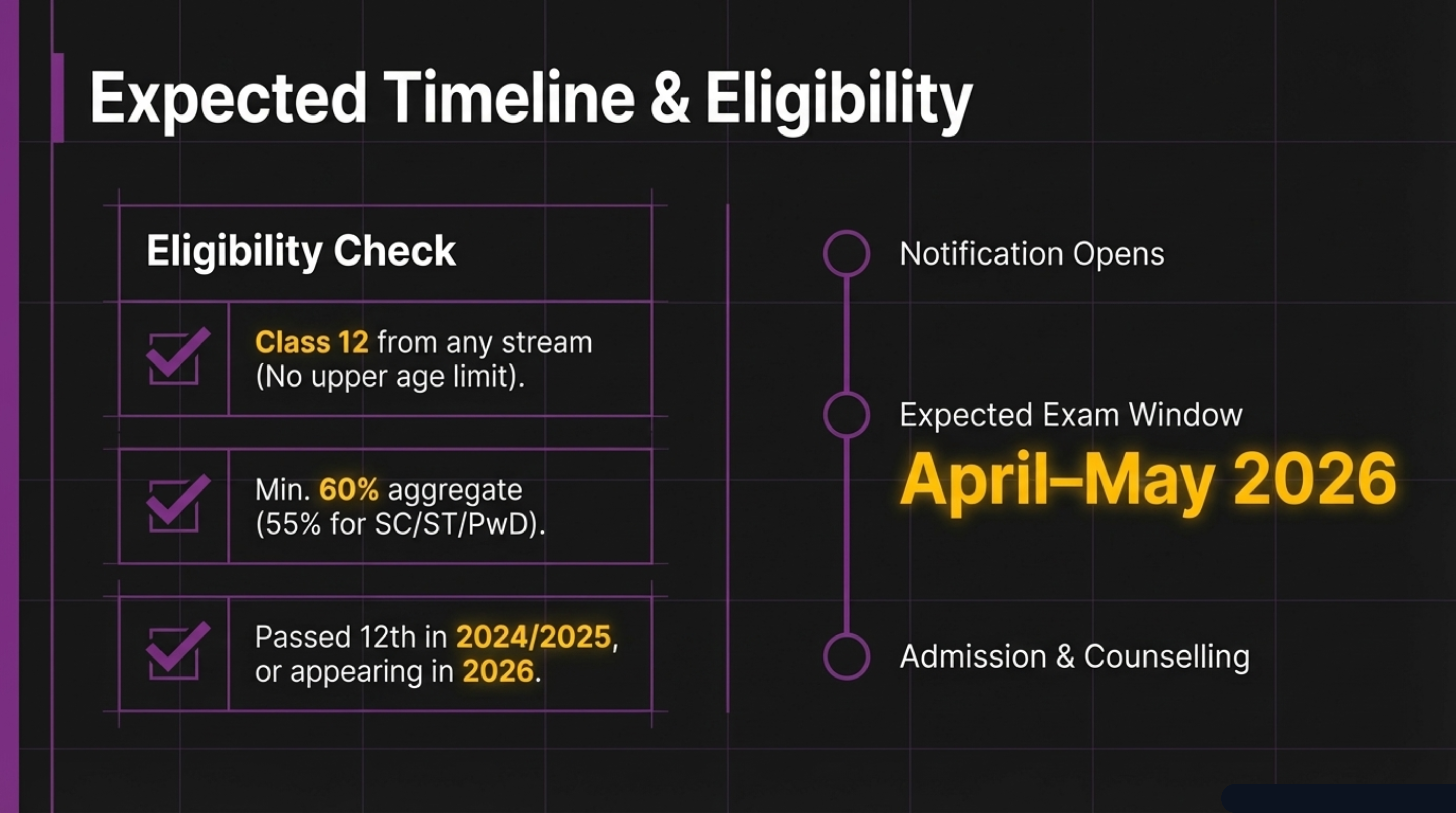
| Notification & Registration Opens | March–April 2026 |
| Last Date to Apply | April–May 2026 |
| Admit Card Release | 1–2 weeks before exam |
| JIPMAT 2026 Exam Date | April–May 2026 |
| Result Declaration | June 2026 |
| Counselling & Admission | June–July 2026 |
Application Fee:
| Category | Fee |
|---|---|
| General / OBC | ₹2,000 |
| SC / ST / PwD / EWS / Transgender | ₹1,000 |
| International Applicants | ₹10,000 |
Registration is done through the official NTA portal at nta.ac.in. Candidates must upload scanned copies of their photograph, signature, and category certificate (if applicable).
Pro tip: The JIPMAT 2025 notification was delayed compared to earlier years. Do not wait for the notification to start preparation — the syllabus and exam pattern have remained consistent since 2021.
JIPMAT 2026 Exam Pattern & Marking Scheme
JIPMAT is a straightforward, single-session, computer-based test. There are no subjective questions, no essay components, and no sectional time limits — which gives test-takers flexibility in time allocation.
| Parameter | Details |
|---|---|
| Exam Mode | Computer-Based Test (CBT) |
| Duration | 150 minutes (2.5 hours) |
| Total Questions | 100 MCQs |
| Total Marks | 400 |
| Correct Answer | +4 marks |
| Wrong Answer | –1 mark |
| Unattempted | 0 marks |
| Sectional Time Limit | None |
| Language | English |
Section-wise distribution:
| Section | Questions | Maximum Marks |
|---|---|---|
| Quantitative Aptitude (QA) | 33 | 132 |
| Data Interpretation & Logical Reasoning (DILR) | 33 | 132 |
| Verbal Ability & Reading Comprehension (VARC) | 34 | 136 |
| Total | 100 | 400 |
The absence of a sectional time limit is a distinct advantage for students who are strong in one area. If you can clear your strongest section quickly, you get extra time for sections that need more careful work.
Negative marking matters more than most students realise. At –1 per wrong answer, every four incorrect responses wipe out one correct answer entirely. A student scoring 60 correct and 20 wrong gets 220 marks (240 – 20). A more disciplined student scoring 55 correct and 5 wrong gets 215 marks (220 – 5) — nearly the same score with five fewer correct answers. Accuracy is the real differentiator.
JIPMAT 2026 Eligibility Criteria
Before registering, candidates must confirm they meet all eligibility requirements. Here is the eligibility matrix:
| Parameter | Requirement |
|---|---|
| Qualifying Exam | Class 12 (or equivalent) from a recognised board |
| Year of Passing | 2024 or 2025 (passed), or appearing in 2026 |
| Class 10 Completion | 2021 or later |
| Minimum Marks (General / EWS / OBC) | 60% aggregate in Class 12 |
| Minimum Marks (SC / ST / PwD) | 55% aggregate in Class 12 |
| Stream | Any stream (Science, Commerce, Humanities) |
| Age Limit | No upper age limit |
| Nationality | Indian citizens and international applicants |
A few things students often miss: there is no restriction on the board (CBSE, ICSE, State Boards are all accepted), no restriction on the stream, and no upper age limit. The Class 10 completion year requirement (2021 or later) effectively means that candidates who are too many years out of school cannot apply — this keeps the cohort young.
Compare your JIPMAT profile with our free IPMAT Predictor tool — see your admission chances at IIM Jammu and IIM Bodh Gaya → ipmcareer.com/predictor
JIPMAT 2026 Syllabus: Section-Wise Breakdown
NTA does not publish a fixed syllabus document, but analysis of past papers (2021–2025) reveals consistent patterns. The difficulty level falls between Class 11–12 board exams and competitive exams like CAT — closer to the former for VARC and closer to the latter for QA.
Quantitative Aptitude (33 Questions)
| Topic Cluster | Key Topics | Expected Questions |
|---|---|---|
| Arithmetic | Percentages, Profit & Loss, SI/CI, Ratio & Proportion, Time-Speed-Distance, Time & Work, Mixtures & Alligations | 12–15 |
| Algebra | Linear Equations, Quadratic Equations, Inequalities, Progressions (AP, GP, HP) | 6–8 |
| Number System | Divisibility, Factors, Remainders, HCF/LCM, Base System | 4–6 |
| Geometry & Mensuration | Triangles, Circles, Quadrilaterals, Areas, Volumes, Coordinate Geometry | 4–6 |
| Modern Maths | Permutations & Combinations, Probability, Set Theory | 3–5 |
Most QA questions are at the Class 11 NCERT level. Students who have covered RS Aggarwal’s Quantitative Aptitude will find 70–80% of the QA section straightforward.
Data Interpretation & Logical Reasoning (33 Questions)
| Topic Cluster | Key Topics | Expected Questions |
|---|---|---|
| Data Interpretation | Bar Graphs, Pie Charts, Line Graphs, Tables, Caselets | 10–14 |
| Analytical Reasoning | Seating Arrangements (Linear & Circular), Puzzles, Grouping | 8–10 |
| Logical Reasoning | Blood Relations, Coding-Decoding, Syllogisms, Statements & Assumptions | 6–8 |
| Verbal Logic | Critical Reasoning, Cause-Effect, Statement-Conclusion | 4–6 |
DILR is where the exam tests patience and method. DI questions are calculation-heavy but formula-light — you need speed with percentages and ratios, not advanced maths. LR questions reward systematic tabulation over gut instinct.
Verbal Ability & Reading Comprehension (34 Questions)
| Topic Cluster | Key Topics | Expected Questions |
|---|---|---|
| Reading Comprehension | 3–4 passages (350–500 words each) with inference, vocabulary-in-context, and main-idea questions | 12–16 |
| Grammar | Sentence Correction, Error Spotting, Fill in the Blanks | 6–8 |
| Vocabulary | Synonyms, Antonyms, Idioms, One-word Substitution | 4–6 |
| Verbal Reasoning | Para Jumbles, Para Completion, Summary Questions | 4–6 |
RC passages are typically drawn from social sciences, economics, business, and current affairs. They are shorter and more straightforward than CAT-level passages — but the questions can be tricky, especially inference-based ones.
IIM Jammu IPM 2026: Fees, Seats & Placements
IIM Jammu launched its IPM programme in 2021 and has quickly built a reputation as one of the stronger new-generation IIMs.
| Parameter | Details |
|---|---|
| Programme | 5-Year Integrated Programme in Management (BBA + MBA) |
| Total Seats | 120–140 |
| Total Fees (5 Years) | ₹30,85,200 approximately |
| Fees (Years 1–3, BBA Phase) | ₹16,06,000 approximately |
| Fees (Years 4–5, MBA Phase) | ₹17,15,000 approximately (aligned with MBA fees) |
| Offer Acceptance Amount | ₹50,000 (adjusted against Semester I fees) |
| Selection Criteria | 95% JIPMAT Score + 5% Gender Diversity |
Placement Snapshot
| Metric | Value |
|---|---|
| Highest Package | ₹31 LPA |
| Average Package | ₹16.04 LPA |
| Placement Rate | 100% |
While the IPM batch at IIM Jammu has not yet completed a full five-year cycle for all batches, the MBA-level placements provide a strong proxy. The ₹16+ LPA average for a relatively new IIM is competitive, especially when you factor in that IPM graduates enter the job market at 22–23 years old — five to six years younger than the typical MBA graduate.
The campus is located in Jammu (Jagti), with a permanent campus under development. Key recruiters include consulting firms, FMCG companies, and IT/analytics firms.
IIM Bodh Gaya IPM 2026: Fees, Seats & Placements
IIM Bodh Gaya also launched its IPM programme alongside IIM Jammu and has been expanding its batch size steadily.
| Parameter | Details |
|---|---|
| Programme | 5-Year Integrated Programme in Management (BBA + MBA) |
| Total Seats | 120 (Indian students) |
| Total Fees (5 Years) | ₹37,99,520 approximately |
| Fees (Years 1–3, BBA Phase) | ₹18,47,520 approximately |
| Fees (Years 4–5, MBA Phase) | ₹19,52,000 approximately |
| Gender Diversity | Up to 30% seats may be reserved for female candidates |
| Reservation | SC, ST, NC-OBC, EWS, PwD as per Government of India norms |
Placement Snapshot
| Metric | Value |
|---|---|
| Highest Package | ₹22 LPA |
| Average Package | ₹13.30 LPA |
IIM Bodh Gaya’s fees are higher than IIM Jammu’s, while its average placement figures are currently lower. That gap may narrow as the institute matures, but as of 2026, the ROI comparison favours IIM Jammu on paper. That said, IIM Bodh Gaya offers the same dual-degree structure (BBA + MBA) and the IIM brand on your resume — which carries significant weight in the Indian job market.
Side-by-Side: IIM Jammu vs IIM Bodh Gaya IPM
| Parameter | IIM Jammu | IIM Bodh Gaya |
|---|---|---|
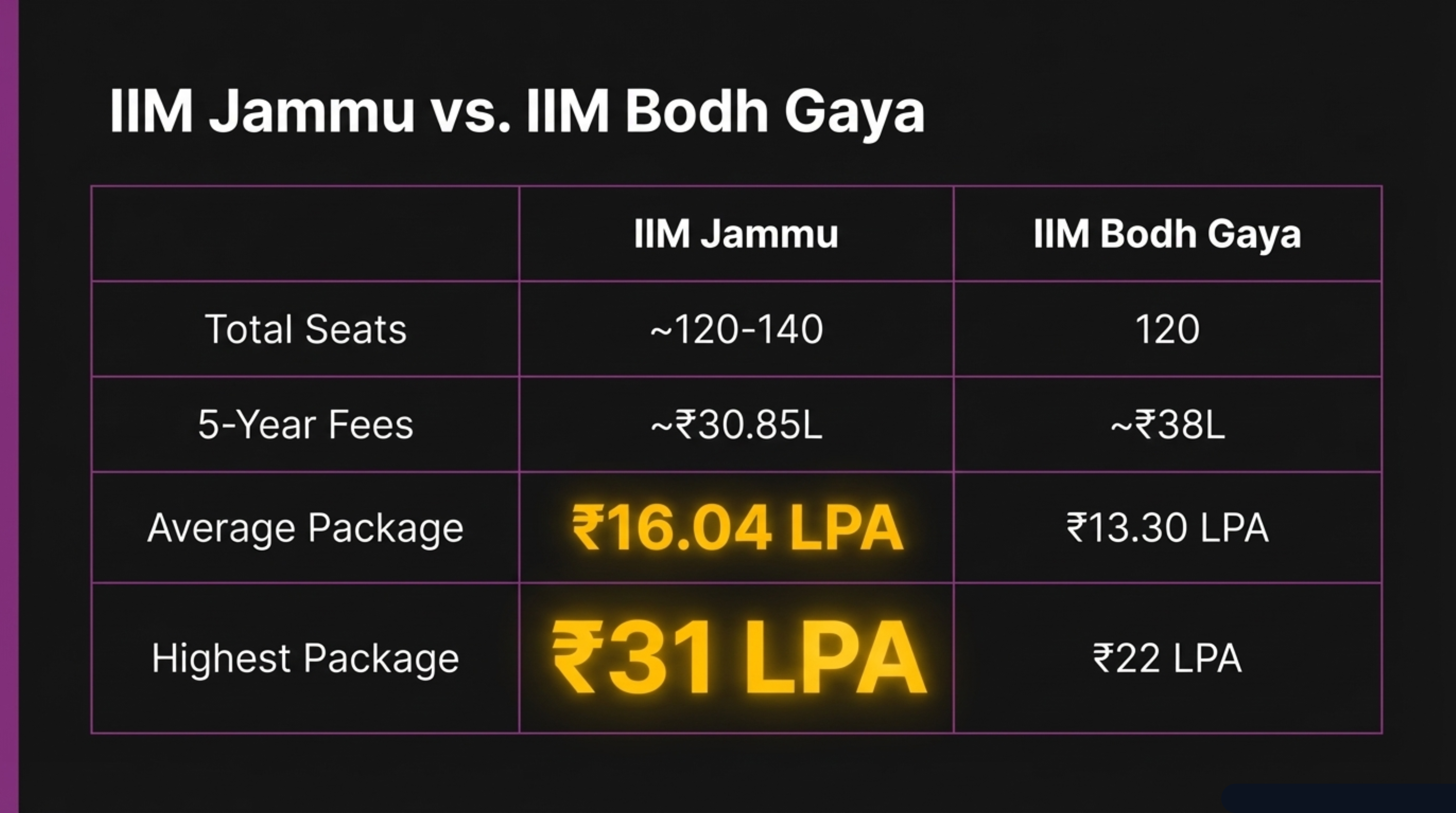
| Total Fees (5 years) | ~₹30.85 lakh | ~₹38 lakh |
| Seats | 120–140 | 120 |
| Highest Package | ₹31 LPA | ₹22 LPA |
| Average Package | ₹16.04 LPA | ₹13.30 LPA |
| Location | Jammu (J&K) | Bodh Gaya (Bihar) |
| Permanent Campus | Under development | Under development |
Seats are filling fast. Enrol in IPM Careers’ JIPMAT 2026 Crash Course — structured preparation with mock tests, mentorship, and section-wise strategy → ipmcareer.com/courses
or you can Call @8299470392
JIPMAT Cutoff Trends: Category-Wise Analysis
Understanding cutoff trends helps set a realistic target score. JIPMAT cutoffs vary between IIM Jammu and IIM Bodh Gaya, and both institutes release separate cutoffs for different categories.
Expected JIPMAT 2026 Cutoff Ranges [VERIFY BEFORE PUBLISHING]
| Category | IIM Jammu (Expected Range) | IIM Bodh Gaya (Expected Range) |
|---|---|---|
| General | 300–350 | 280–330 |
| EWS | 280–330 | 260–310 |
| NC-OBC | 260–300 | 240–280 |
| SC | 200–240 | 180–220 |
| ST | 140–170 | 130–160 |
| PwD | 140–170 | 130–160 |
Important: These are estimated ranges based on trends from 2021–2025. Actual cutoffs depend on the number of applicants, exam difficulty, and the number of available seats in each cycle.
What a 300+ Score Actually Requires
To score 300 out of 400, a student needs roughly 80 correct answers with no more than 20 wrong answers. That works out to approximately:
- 26–27 correct in QA (out of 33)
- 26–27 correct in DILR (out of 33)
- 27–28 correct in VARC (out of 34)
That level of accuracy — around 80% — is achievable with 3–4 months of focused preparation if you are currently strong in at least one section.
How to Prepare for JIPMAT 2026: Section-Wise Strategy
Quantitative Aptitude Strategy
Start with NCERT Mathematics textbooks for Class 10 and 11 — they cover 60–70% of the QA syllabus directly. Once fundamentals are solid, move to topic-specific practice.
Priority order (by frequency in past papers): Percentages and Ratio → Time-Speed-Distance → Algebra → Number System → Geometry → PnC and Probability.
Spend the first month building accuracy on Arithmetic topics. Speed comes from repeated practice, not from learning shortcuts too early. Solve 20–25 problems per day, starting at easy difficulty and gradually increasing.
Tip: Maintain an error log. Track every question you get wrong, categorise it by topic, and revisit those topics weekly. Students who maintain error logs consistently improve accuracy by 15–20% over two months.
Data Interpretation & Logical Reasoning Strategy
DI is essentially applied arithmetic — percentages, averages, and ratios in a graphical or tabular context. If your QA fundamentals are strong, DI becomes manageable.
For LR, practice one set-based puzzle daily. Seating arrangements (linear and circular) and grouping puzzles appear in almost every JIPMAT paper. Build a habit of tabulating conditions neatly before attempting questions — rushing into LR sets without a framework is the single biggest time-waster.
Daily practice target: 2 DI sets + 1 LR set (15–20 minutes each).
Verbal Ability & Reading Comprehension Strategy
Read one long-form article daily from publications like The Hindu, Mint, or LiveMint. Focus on social science, economics, and business topics — these mirror JIPMAT RC passages closely.
For grammar, Wren & Martin’s High School English Grammar is sufficient. Focus on subject-verb agreement, tense consistency, modifier placement, and parallelism — these cover 80% of grammar questions.
For vocabulary, Norman Lewis’s Word Power Made Easy is the standard recommendation. Cover one chapter per week and revise actively using flashcards.
Tip: When practising RC, time yourself. Aim to read a 400-word passage and answer 4 questions in under 8 minutes. If you are spending more than 10 minutes per passage during the actual exam, you will run short on time.
Best Books & Resources for JIPMAT 2026
| Resource | Author / Publisher | Best For | Difficulty Level |
|---|---|---|---|
| NCERT Maths (Class 10 & 11) | NCERT | QA fundamentals | Easy–Moderate |
| Quantitative Aptitude | RS Aggarwal | QA practice | Moderate |
| How to Prepare for Quantitative Aptitude for CAT | Arun Sharma | Advanced QA | Moderate–Hard |
| High School English Grammar & Composition | Wren & Martin | Grammar | Easy–Moderate |
| Word Power Made Easy | Norman Lewis | Vocabulary | Moderate |
| A Modern Approach to Logical Reasoning | RS Aggarwal | LR practice | Moderate |
| Data Interpretation (CAT) | Arun Sharma | DI sets | Moderate–Hard |
| Previous Year JIPMAT Papers (2021–2025) | NTA | Exam familiarity | Actual exam level |
Beyond books, take at least 15–20 full-length mock tests in the final two months. Mock tests are non-negotiable — they build exam temperament, improve time management, and reveal weak areas that self-study alone cannot surface.
Common Mistakes to Avoid
- Over-preparing one section and neglecting others. JIPMAT awards equal weight to all three sections. A student scoring 120/132 in QA but 60/136 in VARC will lose to a balanced scorer every time.
- Ignoring negative marking during mocks. Many students attempt 90+ questions and get 25–30 wrong. That costs 25–30 marks in penalties. Attempting 75 questions with 90% accuracy (67 correct, 8 wrong) yields a better score.
- Starting preparation too late. Three to four months of consistent effort is the minimum for a 300+ score. Students who start in the month before the exam rarely cross the general cutoff.
- Not taking enough mock tests. Solving chapters from books builds knowledge. Mock tests build exam skills — pacing, section-switching, and stress management. These are different abilities, and both are required.
- Relying on coaching class notes without self-practice. Notes give you theory. Practice gives you speed. Most JIPMAT questions are not conceptually hard — they test how quickly and accurately you can apply basic concepts under time pressure.
- Skipping DI sets during preparation. DI is the most “improvable” section. Students who practice 2 DI sets daily for 60 days typically see a 30–40 mark improvement in this section alone.
- Not reading the question carefully. At least 5–8 marks per exam are lost to misreading — confusing “percentage increase” with “percentage of,” or missing a “not” in a logical reasoning question.
JIPMAT vs IPMAT: Key Differences
Students preparing for IPM programmes often confuse JIPMAT with IPMAT. Here is how they differ:
| Parameter | JIPMAT | IPMAT (Indore) | IPMAT (Rohtak) |
|---|---|---|---|
| Conducting Body | NTA | IIM Indore | IIM Rohtak |
| Accepts Score for | IIM Jammu, IIM Bodh Gaya | IIM Indore | IIM Rohtak |
| Exam Mode | CBT (Online) | CBT (Online) | CBT (Online) |
| Total Questions | 100 MCQs | 60 MCQs + 40 SA (QA) | 125 MCQs |
| Total Marks | 400 | 400 | 500 |
| Duration | 150 minutes | 120 minutes | 150 minutes |
| Sections | QA, DILR, VARC | QA (MCQ + SA), VARC | QA, LR, VARC |
| Negative Marking | –1 per wrong MCQ | –1 per wrong MCQ (no negative for SA) | –1 per wrong MCQ |
| Short Answer Questions | No | Yes (40 QA questions) | No |
Can you prepare for both JIPMAT and IPMAT simultaneously? Yes — and most serious IPM aspirants do. The QA and VARC syllabi overlap significantly. The main additional preparation needed for IPMAT Indore is short-answer type QA practice (no options, no negative marking, higher difficulty). Students who target IPMAT Indore as their primary exam and JIPMAT as a strong backup are typically well-prepared for both.
Frequently Asked Questions about JIPMAT 2026
What is the full form of JIPMAT?
JIPMAT stands for Joint Integrated Programme in Management Admission Test. It is conducted by the National Testing Agency (NTA) for admission to the 5-year IPM programme at IIM Jammu and IIM Bodh Gaya.
When will JIPMAT 2026 registration start?
The JIPMAT 2026 notification has not been released as of March 2026. Based on previous years, registration is expected to open between March and April 2026 on the NTA website.
Is JIPMAT easier than IPMAT Indore?
JIPMAT is generally considered slightly easier than IPMAT Indore. JIPMAT is entirely MCQ-based with Class 11–12 level questions, while IPMAT Indore includes short-answer QA questions at a higher difficulty level. However, JIPMAT cutoffs are proportionally high, so the competition is still significant.
Can I appear for JIPMAT if I am in Class 12 right now?
Yes. Students currently appearing for Class 12 board exams in 2026 are eligible for JIPMAT 2026, provided they meet the minimum marks requirement (60% for General/OBC/EWS, 55% for SC/ST/PwD) when results are declared.
What is a good score in JIPMAT 2026?
A score above 300 out of 400 is competitive for the General category at both IIM Jammu and IIM Bodh Gaya. For reserved categories, the target varies — SC/ST candidates can aim for 200+ to be in a safe zone.
Is there any interview or WAT after JIPMAT?
As of the last cycle, IIM Jammu’s selection process was based on the JIPMAT score (95% weightage) and gender diversity (5% weightage), with no separate interview or WAT round. IIM Bodh Gaya follows a similar process. This could change for 2026 — check the official notification when released.
Can I get a scholarship at IIM Jammu or IIM Bodh Gaya?
Both IIMs offer need-based financial assistance and fee waivers for economically weaker students. SC/ST/PwD candidates may receive additional fee concessions as per government norms. Merit-based scholarships vary by batch — check the institute’s website for the latest details.
How many times can I attempt JIPMAT?
There is no limit on the number of attempts, but the eligibility window is restricted. You must have passed Class 12 in 2024 or 2025, or be appearing in 2026, and your Class 10 must have been completed in 2021 or later. This effectively gives most students two to three attempts.
Is JIPMAT accepted by any IIM other than Jammu and Bodh Gaya?
No. JIPMAT scores are accepted only by IIM Jammu and IIM Bodh Gaya. For IIM Indore, you need IPMAT Indore scores. For IIM Rohtak, you need IPMAT Rohtak scores. For IIM Ranchi, the admission process is separate. Each IIM conducts or specifies its own entrance exam.
What is the difference between JIPMAT and SAT for IIM admissions?
Some IIMs (like IIM Indore for international candidates and IIM Bodh Gaya for certain seats) accept SAT scores as an alternative to IPMAT/JIPMAT. However, for domestic Indian candidates at IIM Jammu and IIM Bodh Gaya, JIPMAT is the primary admission route. SAT is typically relevant only for NRI or international applicants.
Conclusion
JIPMAT 2026 is one of the most straightforward paths to an IIM for a Class 12 student. The exam pattern is predictable, the syllabus is manageable, and the preparation overlaps heavily with other IPM entrance exams. What separates students who clear the cutoff from those who do not is not intelligence — it is consistency, accuracy, and the discipline to practice daily over three to four months.
If you are in Class 11 or 12 and have considered the IPM route, JIPMAT should be on your exam calendar. The ROI of entering an IIM at 17–18 and graduating with a BBA + MBA by 22–23 is hard to match through any other academic pathway in India.
Start with the syllabus, build a daily study schedule, take weekly mocks, and track your progress. The exam rewards methodical preparation, not last-minute cramming.
Ready to crack JIPMAT 2026? Join IPM Careers’ JIPMAT + IPMAT Comprehensive Course — 500+ students enrolled, structured mentorship, and 20+ full-length mocks → ipmcareer.com/courses
Join Best IPMAT Coaching in India Now
Have a look at our best courses for your IPMAT Preparation.
Checkout our variety of courses for your IPMAT Preps.
Useful Links :