
The board exams are over, and for most students, that means it’s time to relax. But if you’re serious about cracking the IPMAT 2026, this is the best time for you.
You’re left with 45 days before the exam.
But the question remains:
Can you really crack the IPMAT in 45 days?
The answer, as it turns out, is: Yes, you can—but only if you’re strategic.
As a team of experts at IPM Careers, the best IPMAT coaching institute run by IIM Alumni, we’ve witnessed students improving their scores by a tremendous margin in the last 45 days—not by studying more, but by studying smarter.
This blog outlines the entire 45-day plan for you to maximize your chances of getting into IIM Indore.
- 45 days is enough to cover the entire IPMAT Indore syllabus if you follow a structured, week-by-week plan.
- Allocate 40% of study time to Quantitative Aptitude, 35% to Verbal Ability, and 25% to revision and mock analysis.
- Students who take 15+ full-length mocks in the last 45 days score 25–35% higher than those who skip mock practice.
- IPM Careers students who joined the 45-day crash course in 2025 saw an average score improvement of 55% over their diagnostic test.
1. Why 45 Days Is Enough for IPMAT 2026
Board exams end in late March for most CBSE and state board students, leaving roughly 45 days before IPMAT Indore in mid-May 2026. That window is shorter than a school term but longer than most competitive exam crash courses. The data backs this up: across the 2024 and 2025 IPMAT cycles, a significant portion of successful candidates began dedicated preparation only after their Class 12 boards.
The reason this works is straightforward. IPMAT Indore tests two sections: Quantitative Aptitude (MCQ and Short Answer) and Verbal Ability (MCQ and Short Answer). The syllabus overlaps heavily with Class 11–12 Mathematics and English. If you have a reasonable foundation from school, 45 days of focused effort can bridge the gap between board-level preparation and IPMAT-level performance.
However, the key word is focused. Forty-five days of casual study will not produce results. You need a structured plan that allocates every day to a specific purpose. That is exactly what this guide delivers.
Starting your IPMAT prep after boards? Download IPM Careers free resources → ipmcareer.com/free-resources
2. IPMAT Indore 2026: Exam Pattern & What You Are Targeting
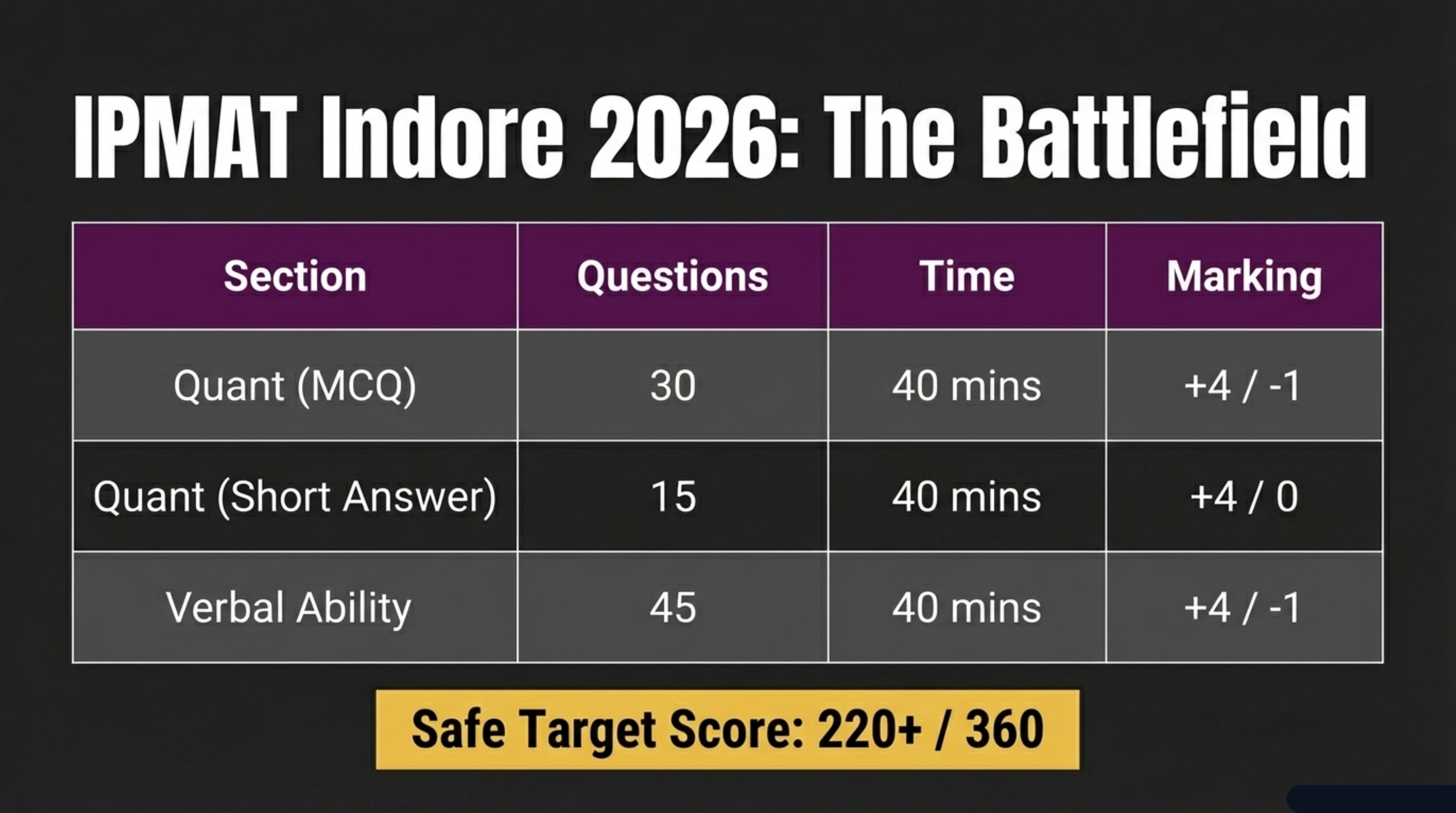
Before mapping out 45 days, you need clarity on what the exam demands. IPMAT Indore follows a two-section, computer-based format with both MCQ and Short Answer (SA) questions. Here is the breakdown:
| Section | Number of Questions | Time Duration |
| Quantitative Aptitude (MCQ) | 30 | 40 minutes |
| Quantitative Aptitude (Short Answer) | 15 | 40 minutes |
| Verbal Ability (MCQ) | 45 | 40 minutes |
- Total Duration: 120 minutes
- Total Questions: 90
Marking Scheme for IIM Indore 2026
| Question Type | Correct | Incorrect | Unattempted |
| QA (MCQ) | +4 | -1 | 0 |
| QA (SA) | +4 | 0 | 0 |
| VA | +4 | -1 | 0 |
Exam pattern for 2026 may have changes from the official IPMAT notification.
Your target score depends on the category you are applying under. Historically, the general category cutoff for IPMAT Indore has ranged between 170–210 out of 360. That means scoring 220+ gives you a comfortable buffer. For reserved categories, the range is typically 30–50 marks lower.
3. The 45-Day Week-by-Week Study Plan for IPMAT 2026
This is the core of your preparation. Each week has a defined focus, so you never waste a day wondering what to study. The plan assumes 7–8 hours of daily study time.
| Period | Focus Area | QA Topics | VA Topics |
| Week 1 (Day 1–7) | Foundation Building & Diagnostic Test | Number System, Percentages, Ratio & Proportion, Basic Algebra | RC basics, Vocabulary building, Grammar rules |
| Week 2 (Day 8–14) | Core Concepts & Speed Building | Profit & Loss, SI/CI, Time-Speed-Distance, Geometry basics | Para Jumbles, Sentence Completion, Summary writing |
| Week 3 (Day 15–21) | Advanced Topics + First Mock Series | P&C, Probability, Mensuration, Trigonometry | Critical Reasoning, Analogies, Odd One Out, Advanced RC |
| Week 4 (Day 22–28) | Intensive Mock Practice & Gap Analysis | Data Interpretation, Advanced Algebra, Coordinate Geometry | Verbal Reasoning, Inference-based questions, Word Usage |
| Week 5 (Day 29–35) | Weak Area Targeting & Revision | Revise weak chapters, 50+ problems/day from weak areas | Revise idioms, vocabulary, timed RC sets |
| Week 6 (Day 36–45) | Final Sprint: Simulation & Exam Readiness | Full-length mocks every alternate day, formula revision, SA drills | Full mocks, grammar rule revision, timed practice |
Week 1–2: Foundation Building (Day 1–14)
Start with a diagnostic mock test on Day 1. Do not study before this test. Your raw score tells you exactly where you stand. Most students score between 80–140 in their first diagnostic. That is your baseline.
Spend the next 13 days building your conceptual foundation. For Quantitative Aptitude, begin with Number System and Arithmetic topics since these carry the highest weightage in IPMAT. For Verbal Ability, start with Reading Comprehension because it accounts for 40–50% of the VA section marks. Read one editorial from The Hindu or Indian Express daily to build comprehension speed.
Week 3–4: Advanced Topics & Mock Integration (Day 15–28)
By Week 3, you should have covered 60–70% of the syllabus. Now move to advanced topics like Permutation & Combination, Probability, and Data Interpretation in QA, and Critical Reasoning and Inference-based questions in VA.
This is also when your mock test journey begins in earnest. Take your first full-length mock on Day 15 and analyse it for at least 2 hours. Every mock test should be followed by a detailed error analysis: categorise mistakes into conceptual errors, silly mistakes, and time-management failures.
Week 5–6: Revision & Final Sprint (Day 29–45)
The last two weeks are not for learning new concepts. They are for revision, mock test practice, and building exam-day stamina. Take a full-length mock every alternate day. On non-mock days, revise formulas, practice short-answer type questions, and work on your weakest topics.
In the final 3 days before the exam, reduce study hours to 4–5 per day. Focus on formula sheets, vocabulary lists, and light practice. Do not attempt any new mock tests in the last 48 hours.
4. Section-wise Strategy: Quantitative Aptitude, Verbal Ability & Logical Reasoning
Quantitative Aptitude (QA) Strategy
QA carries 180 out of 360 marks in IPMAT Indore. It is the section that separates high scorers from average ones. Your 45-day QA strategy should follow this priority order:
| Topic | Priority | Expected Questions | Days to Allocate |
| Number System & Arithmetic | Very High | 12–15 | 5 days |
| Algebra & Equations | High | 8–10 | 4 days |
| Geometry & Mensuration | High | 6–8 | 3 days |
| P&C and Probability | Medium | 4–6 | 3 days |
| Data Interpretation | Medium | 4–5 | 2 days |
| Trigonometry & Coordinate | Low–Medium | 2–4 | 1 day |
For the Short Answer section, practice writing numerical answers quickly. Many students lose marks here not because they cannot solve the problem, but because they run out of time on calculations. Practice mental math for 15 minutes daily: squares up to 30, cubes up to 15, fraction-to-decimal conversions, and percentage shortcuts.
Verbal Ability (VA) Strategy
VA carries the other 180 marks. Unlike QA, VA improvement does not happen overnight. But in 45 days, you can make significant gains with the right approach.
Spend 30 minutes daily on Reading Comprehension. Start with 500-word passages and gradually move to 800–1000 word ones. Time yourself: you should be able to read and answer 5 questions on a 700-word passage within 8–10 minutes by Week 4.
For Grammar and Vocabulary, maintain a daily word list of 10 new words. Use them in sentences. Review previous days’ words every morning before starting fresh. For grammar, focus on subject-verb agreement, tense consistency, parallelism, and modifier placement since these are the most frequently tested areas.
Logical Reasoning (For IPMAT Rohtak / JIPMAT)
If you are also appearing for IPMAT Rohtak or JIPMAT (IIM Jammu / Bodh Gaya), you need to prepare for a Logical Reasoning section. Allocate 1–1.5 hours daily from Week 2 onwards for LR. Focus on Seating Arrangement, Blood Relations, Syllogisms, and Coding-Decoding as these carry the highest weightage
Want guided section-wise preparation? IPM Careers’ IPMAT Crash Course covers all sections with 300+ practice sets. Enroll now →
ipmcareer.com/courses
5. The Ideal Daily Routine for 45-Day IPMAT Prep
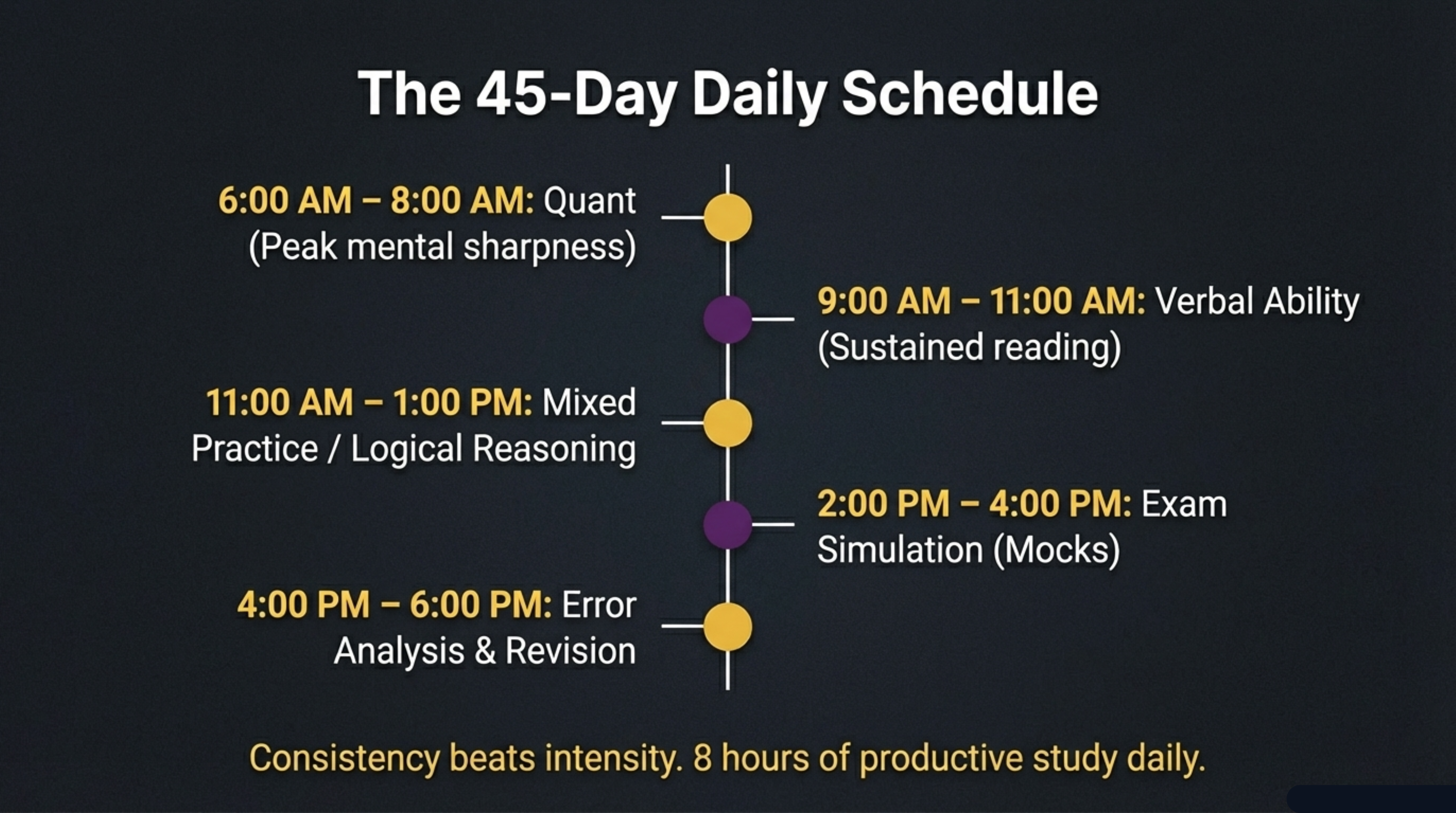
Consistency beats intensity over 45 days. Here is a daily schedule that balances high-output study with necessary rest:
| Time Slot | Activity | Purpose |
| 6:00–8:00 AM | Quantitative Aptitude (new concepts + practice) | Peak mental sharpness for math |
| 8:00–9:00 AM | Break, breakfast, light walk | Reset attention span |
| 9:00–11:00 AM | Verbal Ability (RC + Grammar + Vocab) | Sustained reading & comprehension |
| 11:00 AM–1:00 PM | Mixed practice / LR (if applicable) | Cross-section application |
| 1:00–2:00 PM | Lunch and rest | Recovery |
| 2:00–4:00 PM | Mock test or timed sectional test | Exam simulation & speed building |
| 4:00–5:00 PM | Error analysis and solution review | Learning from mistakes |
| 5:00–6:00 PM | Revision: formulas, word lists, short notes | Long-term retention |
This schedule gives you roughly 8 hours of productive study daily. Adjust timings based on your personal peak hours, but maintain the structure: concept learning in the morning, practice in the afternoon, and revision in the evening.
One critical rule: no phone during study blocks. Put your device in another room or use an app blocker. Research shows that even the presence of a phone on your desk reduces cognitive performance, even if you do not check it.
6. Mock Test Strategy: From Diagnostic to Exam-Ready in 2026
Mock tests are the single most important tool in your 45-day arsenal. Here is how to use them strategically:
| Phase | When | Mocks/Week | Focus |
| Diagnostic | Day 1 | 1 | Baseline score, identify weak areas |
| Sectional | Week 1–2 | 3–4 | Timed practice per section, build speed |
| Full-Length | Week 3–4 | 2 | Exam simulation, time management across sections |
| Intensive | Week 5–6 | 3–4 | Score maximisation, strategy fine-tuning |
The analysis after each mock is more valuable than the mock itself. For every mock test you take, spend at least 60–90 minutes on post-test analysis. Create an error log with four columns: Question Number, Topic, Error Type (Conceptual / Silly / Time), and Corrective Action.
Track your scores week over week. You should see a 10–15% improvement every two weeks. If your scores plateau for more than 10 days, revisit your weak areas or change your practice approach. Students who track their mock scores systematically improve 25–35% more than those who do not.
7. Best Resources & Books for 45-Day IPMAT Prep 2026
| Resource | Author / Source | Best For | Difficulty |
| Quantitative Aptitude for CAT | Arun Sharma | QA concepts & practice | Medium–Hard |
| Word Power Made Easy | Norman Lewis | Vocabulary building | Medium |
| How to Prepare for VA for CAT | Arun Sharma & Meenakshi | RC, Grammar, Verbal Logic | Medium–Hard |
| NCERT Maths (Class 11–12) | NCERT | Foundation concepts, esp. P&C, Probability | Easy–Medium |
| IPM Careers Mock Test Series | ipmcareer.com | IPMAT-specific full-length mocks | Exam Level |
| The Hindu Editorial | Daily newspaper | RC practice + vocabulary in context | Medium |
A word of caution: do not buy more than 2–3 books. In 45 days, you do not have time to cover multiple textbooks. Pick one QA book, one VA book, and rely on a mock test series and online resources for the rest.
Also Read :About CLAT Exam 2027
8. Common Mistakes That Derail 45-Day IPMAT Plans
Mistake 1: Spending too long on theory. In a 45-day window, the ratio should be 30% theory and 70% practice. If you are still reading textbook chapters in Week 4, your plan has gone wrong.
Mistake 2: Ignoring the Verbal Ability section. Many students from science backgrounds focus disproportionately on QA. VA carries equal marks (180/360). A strong VA score is often what separates selected candidates from waitlisted ones.
Mistake 3: Not analysing mock tests. Taking 20 mocks without analysis is worse than taking 10 mocks with thorough analysis. The analysis is where learning happens, not the test itself.
Mistake 4: Attempting every question. IPMAT has negative marking in the MCQ sections. Attempting all 60 MCQs when you are confident about only 40 will hurt your score. Develop a question-selection strategy during mock practice.
Mistake 5: No revision schedule. The human brain forgets 70% of new information within 24 hours without revision. Build 30-minute revision blocks into every day from Day 1.
Mistake 6: Comparing with others on social media. Every student has a different starting point. Someone posting about completing the syllabus in Week 2 might have started preparation 6 months ago. Follow your plan, track your own progress.
Mistake 7: Neglecting health and sleep. Cutting sleep below 6 hours reduces cognitive performance by 15–25%. Your brain consolidates learning during sleep. Eight hours of study on 7 hours of sleep will always beat 12 hours of study on 4 hours of sleep.
9. Frequently Asked Questions About 45-Day IPMAT Preparation
1. Can I crack IPMAT in 45 days with no prior preparation?
Yes, if you have a strong foundation from Class 11–12 Mathematics and English. The IPMAT syllabus overlaps significantly with school-level content. With 7–8 hours of daily focused preparation and 15+ mock tests, 45 days is a realistic window. Students at IPM Careers have done it in previous cycles.
2. How many hours should I study daily during the 45-day plan?
Aim for 7–8 hours of focused study. This does not mean 7–8 hours of sitting at a desk. Use active study techniques: solve problems, take timed tests, analyse errors. Passive reading does not count toward productive study time.
3. Should I join a coaching institute or self-study for 45 days?
It depends on your baseline. If your diagnostic score is below 100/360, structured coaching will save you time because you need concept clarity. If you score above 150, self-study with a good mock test series can work. IPM Careers offers a 45-day crash course designed specifically for post-board-exam preparation.
What if I am also preparing for IPMAT Rohtak and JIPMAT?
The QA and VA sections overlap across all three exams. The additional preparation needed is for Logical Reasoning (Rohtak and JIPMAT). Add 1–1.5 hours of LR practice daily from Week 2 onwards. Focus on Seating Arrangement, Syllogisms, and Coding-Decoding.
How many mock tests should I take in 45 days?
A minimum of 15 full-length mocks. The ideal breakdown: 1 diagnostic, 8–10 sectional mocks in Weeks 1–3, and 12–15 full-length mocks in Weeks 3–6. Some students take up to 20+ full-length mocks. Prioritise quality of analysis over quantity of mocks.
Is the 45-day plan enough for both IPMAT and JEE/Other exams?
Preparing for IPMAT alongside JEE Main is feasible since both share a Mathematics component. However, splitting focus between IPMAT and medical/law entrance exams is not recommended in a 45-day window. Choose one primary target and allocate 80%+ of your time to it.
What is a realistic score target for someone starting after boards?
If you follow this plan consistently, a score of 180–220 out of 360 is achievable in 45 days starting from a moderate baseline. The general category cutoff has historically been around 170–210. Students who complete the full mock schedule often exceed 220.
What should I do in the last 3 days before IPMAT?
Reduce study to 4–5 hours. Revise formula sheets and vocabulary lists. Do not take any new mock tests. Sleep for 7–8 hours. Prepare your exam-day logistics: admit card, ID proof, travel plan. A calm, well-rested mind performs 15–20% better than a stressed, sleep-deprived one.
10. Conclusion
Forty-five days after your board exams is not a limitation. It is a focused sprint that, when planned correctly, can land you a seat at IIM Indore. The students who succeed in this window are not necessarily the most talented ones. They are the most disciplined ones: they follow a week-by-week plan, take mock tests religiously, analyse every mistake, and show up every single day.
This guide has given you the exact blueprint: the week-by-week study plan, the section-wise strategy, the daily routine, the mock test schedule, and the resources you need. The only variable left is your execution.
Start with a diagnostic test today. Map your 45 days. And if you want expert guidance through every step of this journey, IPM Careers has helped hundreds of post-board students convert their IPMAT attempts into IIM admissions.
Join Best IPMAT Coaching in India Now
Have a look at our best courses for your IPMAT Preparation.
Checkout our variety of courses for your IPMAT Preps.
Useful Links :