Most IPMAT aspirants spend 6–12 months building their foundation. The final 15 days before May 4 are not about adding more — they are about sharpening what already exists. This is the window where the gap between aspirants who clear the cutoff and those who miss it by 5–10 marks is actually decided.
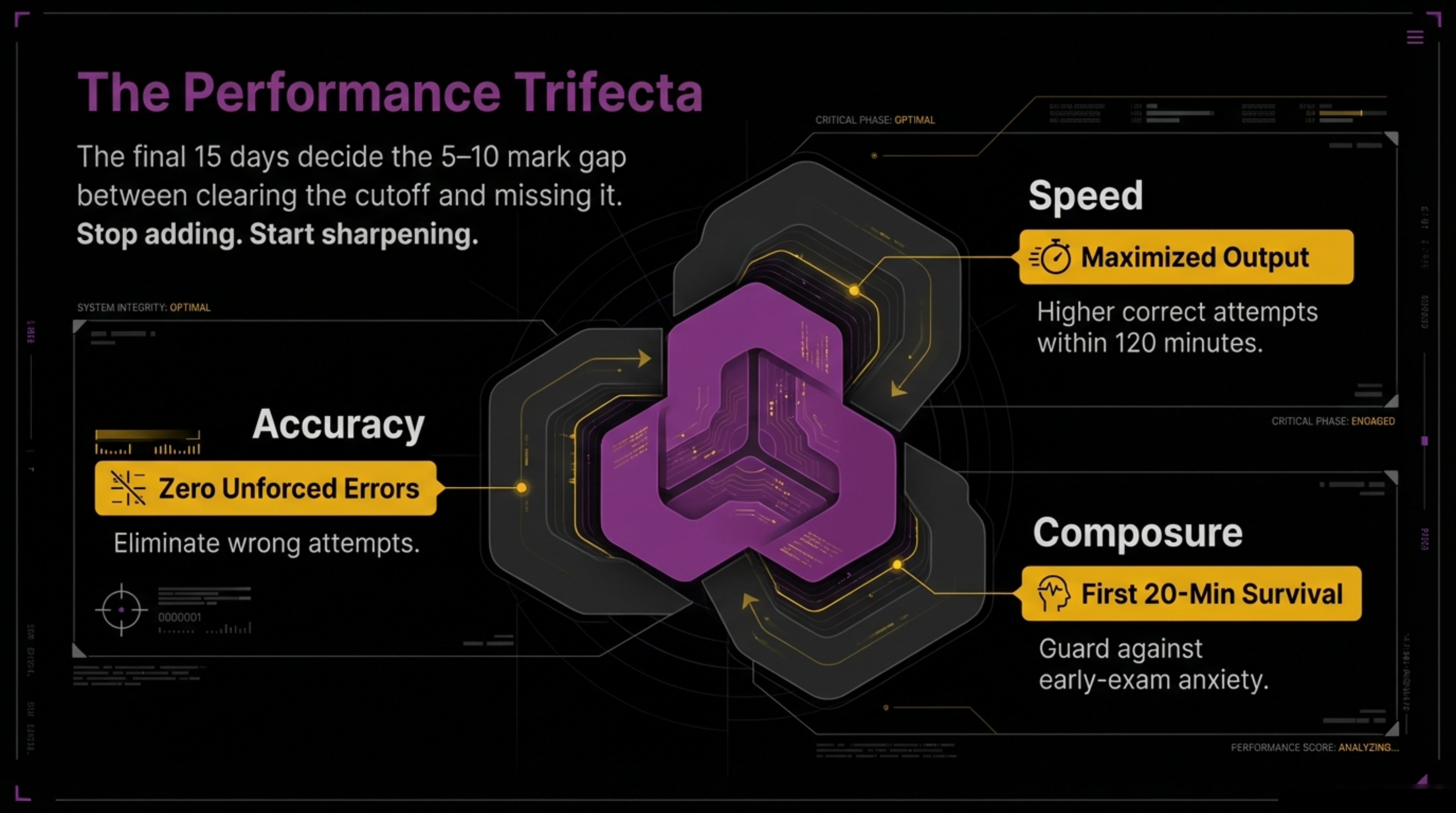
Three factors determine your score here: accuracy (not attempting wrong questions), speed (attempting more correct questions within 120 minutes), and composure (not losing marks in the first 20 minutes due to anxiety). All three are trainable in 15 days — if you are deliberate about it.
Treat this phase as a separate competitive event. Adjust sleep, nutrition, and screen time accordingly.
IPMAT 2026 Exam Pattern at a Glance
Before building a 15-day plan, you need to know exactly what you are optimising for. Here is a quick snapshot of the IPMAT Indore 2026 structure:
| Section | Questions | Marks | Negative Marking | Duration |
|---|---|---|---|---|
| Quantitative Aptitude (QA) | 45 | 180 | −1 per wrong | 120 min (shared) |
| Verbal Ability (VA) | 45 | 180 | −1 per wrong | |
| Total | 90 | 360 | — | 120 min |
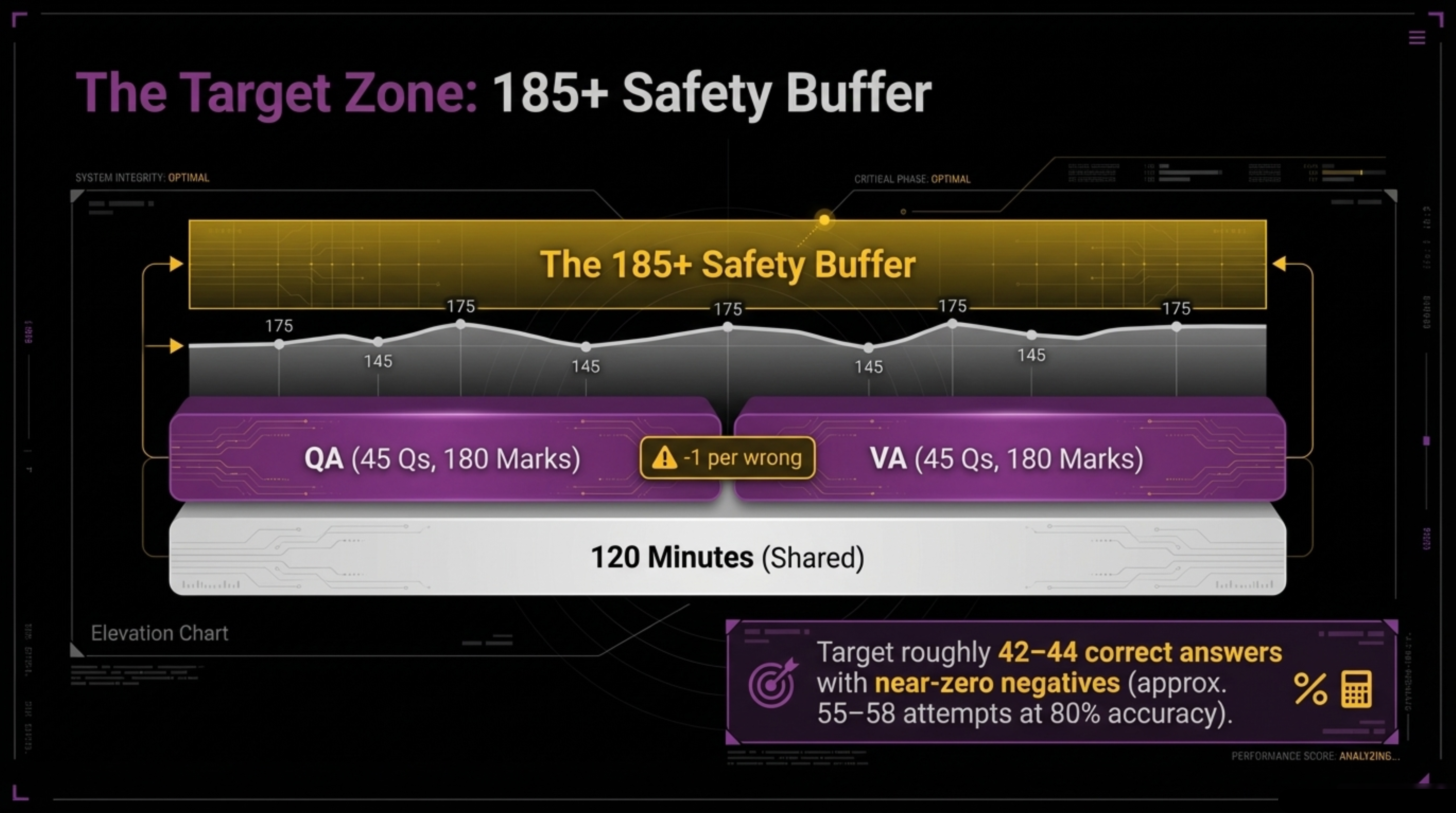
Cutoff benchmark: Historical IPMAT Indore cutoffs have ranged between 145–175 marks depending on year and cohort size. your target score should be 185+ to stay safely above the threshold.
The 15-Day IPMAT 2026 Study Plan: Phase-by-Phase Breakdown
The 15 days are divided into five distinct phases. Each phase has one clear objective. Drifting from the structure collapses the compounding effect the plan is designed to create.
Phase 1 — Days 1–3: Diagnosis Sprint
Objective: Identify your 3 biggest scoring leaks before you start fixing anything.
Take one full-length timed mock on Day 1 under exam conditions — no pauses, no phone. Spend 2–3 hours analysing the results: which question types cost you the most marks? Which did you attempt wrongly (accuracy issue) vs. skip entirely (coverage issue)?
| Day | Activity | Time |
|---|---|---|
| Day 1 | Full mock test — timed, no breaks | 2 hrs |
| Day 1 | Detailed error analysis | 2.5 hrs |
| Days 2–3 | Targeted revision of top 2–3 weak areas | 3 hrs/day |
Tip: Start an Error Log — a notebook or Google Sheet where you write every wrong answer, the correct approach, and the trap you fell into. This becomes your most valuable revision material in Days 13–14.
Phase 2 — Days 4–7: QA Intensive
Objective: Lock in accuracy on high-frequency QA topics and increase correct attempts by 6–10 questions.
IPMAT QA follows a predictable topic distribution. Focus exclusively on topics that appear most frequently and where accuracy improves fastest.
| QA Topic | Typical Weightage | Priority |
|---|---|---|
| Arithmetic (%, Ratio, TW, SI–CI) | 35–40% | High |
| Algebra (Equations / Inequalities) | 20–25% | High |
| Modern Maths (P&C / Probability) | 10–15% | Medium |
| Geometry & Mensuration | 10–15% | Medium |
| Number System | 8–12% | Low (skip if already weak) |
Weightage is based on historical IPMAT Indore papers; distribution can shift year-to-year.
Spend 3 hours daily: 1 hour concept drills, 1 hour topic-wise sectional tests (20–25 questions), 1 hour reviewing mistakes.
Phase 3 — Days 8–10: VA Intensive
Objective: Push VA accuracy above 80% and improve Reading Comprehension speed by at least 20%.
VA tests Reading Comprehension, Vocabulary-in-Context, Grammar (Error Correction, Sentence Completion), and Para-jumbles. The biggest mistake aspirants make is treating VA as a “natural” section that needs no structured practice.
| VA Sub-topic | Recommended Daily Reps |
|---|---|
| Reading Comprehension | 1 passage + questions |
| Vocabulary in Context | 10–15 questions |
| Grammar (Error ID / Fill in blanks) | 15–20 questions |
| Para-jumbles | 5 sets |
The 6-Minute RC Rule: If you cannot finish reading and answering a 4–5 question RC passage in under 6 minutes, you are reading word-by-word. Practice skimming for argument structure — intro claim → supporting evidence → conclusion.
Feeling underprepared with 15 days to go?
IPM Careers’ IPMAT 2026 Crash Course is built specifically for the final sprint — structured mock tests, live doubt sessions, and a curated revision bank.Enrol Now → ipmcareer.com/courses
Phase 4 — Days 11–13: Mock Test Cycle
Objective: Build exam-day rhythm, identify time allocation patterns, and eliminate careless errors.
Take one full mock every day. After each mock, spend equal time on analysis as you did on the test.
| Day | Morning (2 hrs) | Afternoon (2–3 hrs) |
|---|---|---|
| Day 11 | Full Mock #2 | Error analysis + weak area drill |
| Day 12 | Full Mock #3 | Section-wise speed drill |
| Day 13 | Full Mock #4 | Error log review + formula sheet revision |
Track these metrics across all mocks:
- QA vs. VA attempt balance (are you allocating time evenly?)
- Accuracy rate per section — target ≥78%
- Average time per question — target ≤80 seconds
- Unattempted questions — is it a time issue or a confidence issue?
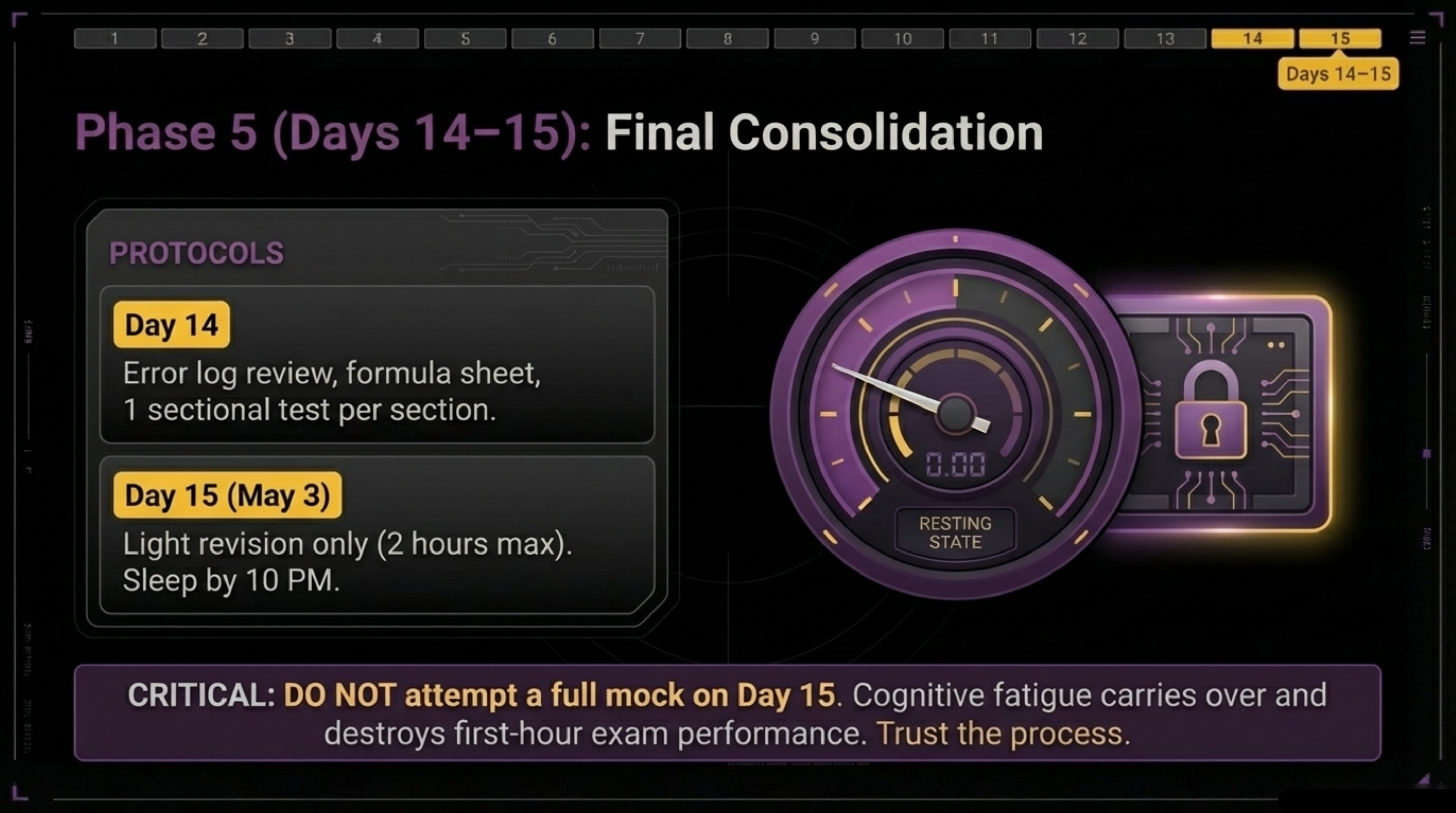
Phase 5 — Days 14–15: Final Consolidation
Objective: No new material. Reinforce what works. Protect your mental state.
| Day | Focus |
|---|---|
| Day 14 | Error log review, formula sheet, 1 sectional test per section |
| Day 15 (May 3) | Light revision only — 2 hours max. Sleep by 10 PM. |
Do not attempt a full mock on Day 15. The cognitive fatigue carries into the next morning and hurts first-hour performance on exam day. Trust the process.
Section-wise Score Maximisation Tips
Quantitative Aptitude
Attempt QA first if it is your stronger section — building early confidence matters. Use the Skip-Flag-Return method: skip anything that takes more than 90 seconds on first pass, flag it, return in the last 15 minutes. Most QA toppers attempt 32–38 questions with 85%+ accuracy rather than rushing through all 45 at 60% accuracy.
Verbal Ability
Start VA with RC passages — they require the most focus and are best tackled when the mind is fresh. Vocabulary and Grammar questions are faster; save them for the mid-to-end window. A realistic target: 35–38 attempts with 82%+ accuracy.
Use IPM Careers’ free IPMAT Predictor to get a personalised cutoff probability before May 4.Try Free IPMAT Predictor →
What NOT to Do in the Last 15 Days
- Don’t start a topic you haven’t touched before. The time cost of learning from scratch exceeds the potential mark gain in this window.
- Don’t skip mock analysis. Taking a mock without analysing it is equivalent to practising free throws without checking if they went in.
- Don’t study past midnight. Sleep is when procedural memory (how to solve problems) consolidates. Sacrificing sleep for 2 extra hours of study is a net negative.
- Don’t compare mock scores with peers. Platforms have different difficulty levels. Track your own improvement curve, not relative rankings.
- Don’t ignore exam-day logistics. Know your centre address, carry valid photo ID, and check reporting time. Avoidable stress on May 4 morning costs marks.
Frequently Asked Questions
Is 15 days enough to clear the IPMAT 2026 cutoff?
For aspirants who have already built their foundation — yes. Fifteen focused days can move a score from 140–150 to 175–185. For someone starting from scratch, 15 days is not enough. This plan is a sprint strategy, not a beginner’s roadmap.
How many mock tests should I attempt in the last 15 days?
A minimum of 4 full-length mocks is recommended — one in Phase 1 (diagnosis), three in Phase 4 (refinement). Quality of analysis matters more than quantity of tests taken.
Should I attempt all 90 questions in the exam?
Not necessarily. A score of 185 can be achieved with roughly 42–44 correct answers and near-zero negatives — approximately 55–58 attempts at 80% accuracy. Blind guessing on remaining questions risks pulling the score down. Only attempt what you are reasonably confident about.
What is the expected IPMAT Indore 2026 cutoff?
Based on historical trends, the IPMAT Indore cutoff has ranged between 145 and 175 marks. The 2026 cutoff will depend on cohort performance and paper difficulty. Always target 185+ to build a safe buffer.
Can I improve my QA score significantly in 15 days?
Yes — especially if your errors are in Arithmetic and Algebra, which together form roughly 60% of the paper. Most aspirants improve QA by 15–25 marks in this window by fixing calculation shortcuts and question-selection strategy, not by learning new topics.
Should I also practise IPMAT Rohtak papers?
If you are appearing for IPMAT Rohtak as well, note that Rohtak additionally includes a Logical Reasoning (LR) section. In the last 15 days, avoid splitting focus across both unless your LR is already strong.
Conclusion
The May 4 exam is not won in the last 15 days — but it can definitely be lost there. Aspirants who treat this final window with the same seriousness as a separate competitive event — structured, analytical, and disciplined — consistently outperform those who simply “study hard” without a system.
Follow the five phases: diagnose, fix QA, fix VA, mock test aggressively, and consolidate. Keep your Error Log updated daily. Protect your sleep. And walk into the exam hall on May 4 knowing you have left nothing on the table.